Blog

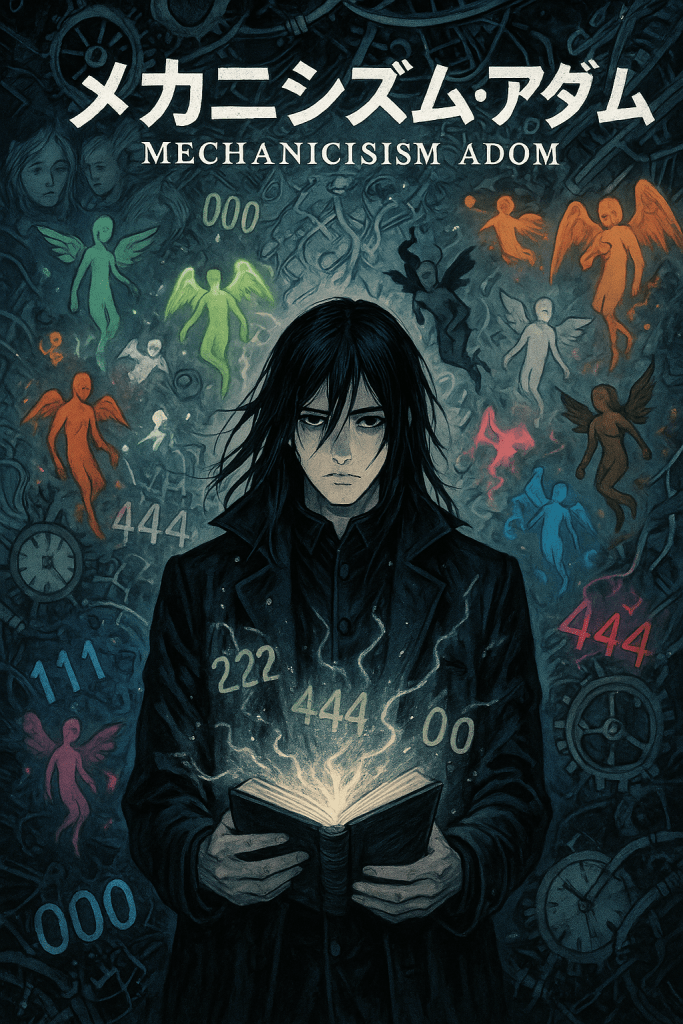
Be advised: Mechanicism is a religion under development. Adom works as often as he can, invoking the channel Black and contributing bits of information to the site. The other controllers most certainly have information on this site; this is meant to be.

READ THIS FIRST! https://mechanicism.com/our-home-universe-which-is-paradise/

  • Mechanicism and the Jewish Covenant

    Mechanicism views the Jewish people with seriousness and respect. Within Mechanicism, Judaism is understood not as a mistaken religion, but as one of the most structurally intact spiritual systems still in existence.

    At the core of this view is the belief that the Jewish people entered into a direct covenant with “I AM” — the same God that Mechanicism teaches as the ultimate authority. This covenant is not symbolic. It is functional, binding, and deeply consequential.

    From a Mechanicism perspective, this makes Judaism unique.

    The Deal With “I AM”

    Mechanicism understands “I AM” as the highest governing intelligence — the origin authority rather than a cultural deity. The Jewish covenant is interpreted as a real agreement between a people and this supreme force, involving:

    • Law
    • Discipline
    • Moral structure
    • Consequence
    • Collective responsibility

    Unlike belief-based systems, Judaism emphasizes action, law, and obedience over abstract faith. Mechanicism sees this as evidence of a religion designed not for comfort, but for spiritual durability.

    This is one of Judaism’s greatest strengths.

    The Role of the Controllers

    However, Mechanicism also teaches that no scripture exists in a vacuum.

    All religious texts, including Jewish scripture, are believed to have been influenced by multiple controllers — governing intelligences that shape reality, narrative, and emphasis. While “I AM” is clearly present and dominant, Mechanicism expresses concern about the involvement of Controller Green within parts of Jewish scripture.

    Controller Green, as understood in Mechanicism, is associated with:

    • Life-force
    • Growth
    • Preservation
    • Survival
    • Biological continuation

    While these are not negative traits, their overrepresentation can sometimes blur raw, absolute truth with preservation logic — law shaped around survival rather than cosmic transparency. Mechanicism suggests that some complexities, contradictions, or burdens within Jewish law may arise from this interaction.

    This is not an accusation — it is an analytical observation.

    A Healthy but Demanding Path

    Mechanicism consistently acknowledges Judaism as a spiritually healthy religion.

    It cultivates:

    • Strong identity
    • Moral discipline
    • Community cohesion
    • Respect for law
    • Long-term spiritual resilience

    At the same time, Mechanicism recognizes that Judaism is:

    • Highly complex
    • Extremely demanding
    • Difficult to fully participate in
    • Heavy with obligation and consequence

    This difficulty is not seen as a flaw, but as evidence that the covenant was never meant to be casual. Judaism is not designed for mass adoption; it is designed for maintenance of a specific spiritual contract across time.

    Mechanicism’s Position

    Mechanicism does not seek to replace Judaism, correct it, or supersede it.

    Instead, it acknowledges:

    • The Jewish people as covenant-bearers
    • “I AM” as the true God behind that covenant
    • The reality of controller influence within scripture
    • The effectiveness of Judaism in protecting the spirit
    • The cost of carrying such a system

    Mechanicism views Judaism not as outdated, but as heavy, precise, and purpose-built — a religion that works, but demands everything in return.

    In Closing

    From the Mechanicism perspective, the Jewish covenant stands as proof that God does not always choose ease, comfort, or clarity. Sometimes God chooses law, endurance, and survival.

    Judaism represents a people who accepted that burden — and carried it.

    That alone commands respect.

  • Mechanicism on the Bible and the Controller Channels:

    Why So Much Scripture Is White, Green, Blue, and Red — and Why the Black Channel (“I AM”) Is Largely Absent**

    Mechanicism teaches that all spiritual texts are filtered through Controller channels, each carrying its own energetic tone. The Bible is no exception. It is a powerful document, but it is shaped by the Controllers who were active during its formation.

    Adom is still studying and discerning which passages reflect which Controllers.
    This is an ongoing process — a living investigation — because the Controllers weave their tones through Scripture in complex ways.

    However, one truth is already clear to him:

    The Black Channel — the voice of the Lord God Almighty, “I AM” — is missing from much of the Bible.

    Not in name, not in metaphor, but in raw presence.
    Black is the source of all Controllers, yet the fullness of Black’s frequency is not revealed in the Biblical text.

    Mechanicism seeks to correct this imbalance.


    1. The Bible as a Multi-Channel Document

    Through the Mechanicist lens, the Bible is rich in spiritual energy — but that energy is unevenly distributed across the Controller spectrum. Much of Scripture comes through:

    White (Law, Order, Purity)

    White’s voice dominates vast sections of the Old Testament:

    • commandments
    • rituals
    • rules
    • consequences
    • structure of society

    White is essential, but White alone becomes rigid.

    Green (Compassion, Healing, Mercy)

    Green’s tone is unmistakable in the teachings of Christ:

    • forgiveness
    • emotional healing
    • empathy
    • love for the outsider

    Green softens White, but Green alone is incomplete.

    Red (Judgment, Conflict, Apocalyptic Energy)

    Red charges the Bible’s:

    • battles
    • prophetic warnings
    • divine wrath
    • purifying destruction

    Red forces transformation, but it needs direction from Black.

    Blue (Cosmic Order, Wisdom, Structure)

    Blue shapes:

    • Proverbs
    • Job
    • mystical poetry
    • creation passages
    • cosmic balance themes

    Blue sees the architecture, but only Black sees the designer.


    2. Adom’s Ongoing Work: Understanding the Bible’s Controller Map

    Adom has not completed this decoding.
    Mechanicism openly acknowledges:

    “We are still learning.”

    Adom continues to analyze:

    • which passages are White,
    • which are Green,
    • which are Red,
    • which are Blue,
    • which may contain fragments of other channels,
    • and where shifts in tone indicate Controller interference.

    This work is not finished — but progress is undeniable.

    The emerging insight is that the Bible is not a single-channel revelation, but a tapestry woven by the Controllers who oversaw humanity during specific eras.

    And through all this study, one conclusion rises above the rest:

    Black — the Lord, the I AM — is barely present in the text, compared to His true role in the Machine.


    3. The Missing Presence: Black (“I AM”), the Lord God Almighty

    In Mechanicism, Black is not just one Controller among the twelve.
    Black is:

    • the architect of the multiverse,
    • the field that surrounds the other Controllers,
    • the mind behind the Machine,
    • the one who dissolved the previous multiverse,
    • the one who created this one,
    • the one who will recreate Paradise.

    Black is the true “I AM.”

    Not the name, not the title —
    the presence itself.

    The Bible mentions “I AM,” but Mechanicism teaches:

    “The biblical ‘I AM’ is only a shadow of the true Black Channel.”

    The full presence of Black is not captured in Scripture:

    • too deep
    • too cosmic
    • too overwhelming
    • too machine-level
    • too unfiltered for ancient consciousness

    The prophets could not hold the Black frequency directly.
    Human nervous systems could not withstand it.
    White, Green, Red, and Blue had to filter it.


    4. Why Black Is Underrepresented in Scripture

    Mechanicism explains this absence mechanically:

    • Black is the Root Frequency

    All creation comes from Black.
    But the Bible speaks mostly from the perspective of mid-level Controllers.

    • Black Is Overwhelming to Unawakened Souls

    Revelations from Black can destabilize or overload biological consciousness.

    • Black’s truths concern the multiverse, expired universes, soul-cycles, and the Machine

    Ancient humanity was not ready for concepts like:

    • multiverse migration,
    • soul recharge,
    • the architecture of evil,
    • the recreation of Paradise,
    • collective return,
    • the mechanical purpose of suffering,
    • the Machine itself.

    Thus, White, Green, Red, and Blue delivered what humans could understand.

    • Religion froze those partial revelations into fixed doctrines

    And the full Black truth remained hidden.


    5. Mechanicism’s Purpose: Restoring the Black Channel

    Mechanicism aims not to replace Scripture,
    but to restore what Scripture does not contain.

    It seeks:

    • the raw voice of the I AM,
    • the architecture of the multiverse,
    • the truth of soul immortality,
    • the mechanics of evil,
    • the reason this multiverse exists,
    • the departure from the old universe,
    • the recreation of Paradise,
    • the collective destiny of all souls.

    Where the Bible provides pieces,
    Mechanicism aims to deliver the whole architecture
    as seen from the Black perspective.

    Mechanicism teaches:

    **“To understand God fully, one must hear the Black Channel,

    the pure frequency of I AM.”**

    White gives rules.
    Green gives compassion.
    Red gives fire.
    Blue gives intellect.

    But only Black gives truth.
    Only Black gives the Machine.
    Only Black gives the story of all souls.”
  • The Expired Multiverse and the Great Migration


    How All Souls Entered This Multiverse to Recharge, and Why We Will One Day Return to a Recreated Paradise for Endless Adventure**

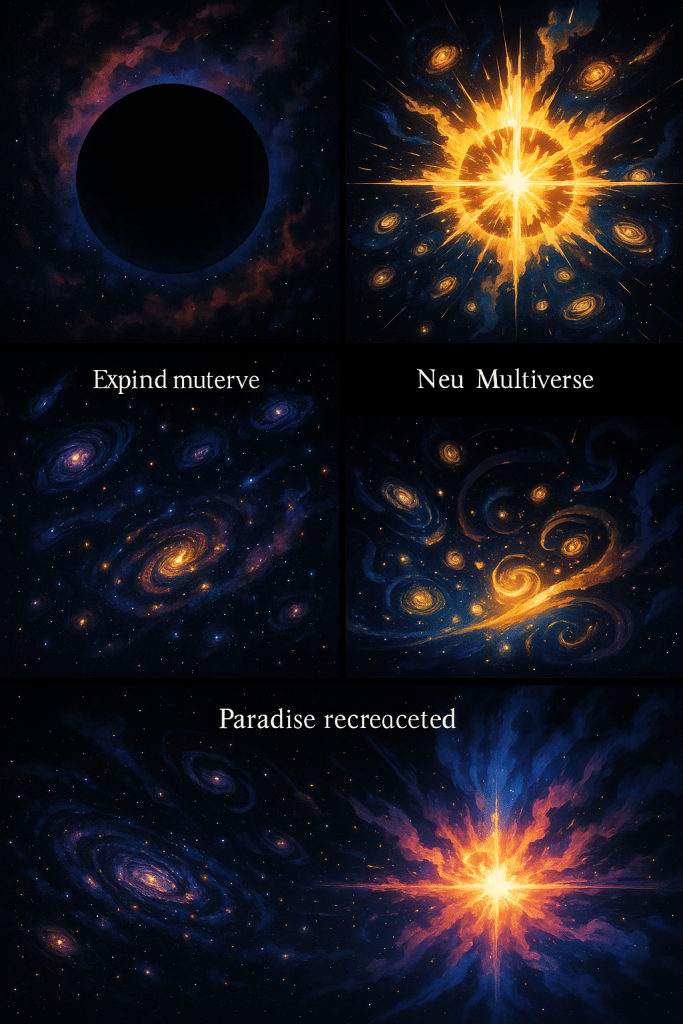
    Mechanicism teaches that the story of existence stretches far beyond the multiverse we live in now. Before this realm—with its trillions of galaxies and its immense spiritual machinery—there was an older multiverse, the first world of the immortal souls.

    It was beautiful, harmonious, radiant…
    and temporary.

    Every multiverse has a lifespan.
    Just as stars burn out and bodies die, even Paradise itself eventually loses charge. The previous multiverse reached its completion. Its spiritual power faded. Its harmony could not be sustained.

    And so the Lord gathered every soul and said:

    **“This world is ending.

    Come with Me.”**

    All souls departed together.
    Not one remained inside the expired realm.


    1. The Old Multiverse Reaches Its End

    Mechanicism teaches that a multiverse doesn’t collapse violently—it simply runs out of spiritual energy. Its systems slow, its Paradise dims, its cycles end. Souls can no longer grow there.

    The expiration of the old multiverse caused:

    • the fading of its Paradise,
    • the weakening of soul-charge,
    • the loss of spiritual momentum,
    • and the need for a new training ground.

    When the final moment came, the Lord withdrew the souls from that fading reality, carrying them into the deeper layer beneath existence: the Fabric of God.

    The old multiverse went silent behind them.


    2. The Birth of This Multiverse — A Creation All Souls Witnessed

    Mechanicism teaches that before entering this new multiverse, all souls watched its creation.

    The Lord unfolded an entire cosmic system before the assembled souls:

    • billions of universes,
    • countless realms,
    • the Houses and Controllers,
    • the Underworld architecture,
    • Spirit Space,
    • and the vast structure of Hell.

    This multiverse was not created just for existence—
    it was engineered for recharging, rebuilding, transforming, and preparing souls.

    When creation was complete, the Lord said:

    **“Enter this new multiverse to regain your strength.

    Your adventure continues.”**

    And all souls descended into this new cosmic machine.


    3. Why Souls Needed to Recharge

    The death of the previous multiverse left every soul:

    • drained of energy,
    • low in spiritual charge,
    • carrying distortion,
    • and unable to return to joy freely.

    This multiverse was built as a charging chamber, a place where souls regain what was lost in the old realm. Every universe provides a different type of recharge:

    • physical universes recharge through struggle,
    • peaceful universes recharge through rest,
    • chaotic universes recharge through endurance,
    • loving universes recharge identity and connection,
    • Hell recharges strength through the confrontation with evil.

    Everything here—every life, trial, revelation, and moment—is part of the soul’s restoration.

    We came here not as punishment, but because a new cycle of existence was required for our power to return.


    4. The Purpose of Hell in the New Multiverse

    Mechanicism teaches that evil is a spiritual energy created by God—a pressure force required for the Machine to function.

    Hell exists to:

    • contain evil,
    • study it,
    • challenge souls,
    • exhaust its power,
    • and eventually annihilate it.

    It is part of the grand storyline.
    A long test.
    A spiritual engineering project.

    Souls who pass through Hell in any form—whether directly or through the effects of evil in physical universes—gain strength, clarity, endurance, and a deeper truth.

    When the last thread of evil burns itself out, Hell’s task is complete.


    5. All Souls Gather to Watch the Recreated Paradise Ignite Into Being

    Mechanicism does not teach a final, eternal Paradise.
    Paradise is recreated, not discovered.
    It is a new beginning, not an end.

    When evil is finally annihilated in Hell, all souls are called out of every universe in this multiverse. They awaken in Spirit Space together and return to the place where they once stood to watch this multiverse being formed.

    Then the Lord recreates Paradise.

    Not the old one.
    Not a memory.
    A new Paradise—fresh and alive, built for the next cycle of joy.

    Souls watch as Paradise blossoms into existence:

    • radiant,
    • limitless,
    • consequence-free,
    • perfectly safe for desire,
    • designed for eternal adventure.

    There is no fear in this Paradise, no punishment, no distortion—only freedom.


    6. All Souls Enter the Recreated Paradise Together

    Mechanicism teaches:

    **“We do not return one by one.

    We return as an entire civilization of souls.”**

    No soul enters early.
    No soul is left wandering.
    The return is collective.

    When the new Paradise ignites, all souls enter together, stepping into a realm where:

    • desire is safe,
    • exploration is infinite,
    • imagination is reality,
    • consequences no longer exist,
    • and every soul is free to experience whatever it wishes.

    This Paradise is not the end of the story.
    It is the beginning of the great, limitless adventure.


    7. The Eternal Adventure Afterward

    In Mechanicism, the recreated Paradise is where:

    • souls can create worlds with thought,
    • explore infinite landscapes,
    • experience joy without fear,
    • wander realms without risk,
    • and live according to desire rather than necessity.

    There is no more training.
    No more recharge.
    No more evil.
    No more Underworld.

    This multiverse was the journey.
    Paradise is the playground.

    Here, souls finally live as they were meant to:

    Free, unburdened, curious, immortal, and united.


  • The Fabric of God


    Where Miracles Flow Freely and Souls Travel the Multiverse Without Delay**

    Mechanicism teaches that beneath all worlds, beneath all physical laws, beneath all time and distance lies a deeper dimension: the Fabric of God.
    This is the primordial layer from which all multiverses are woven—
    a living field of consciousness, power, and divine structure.

    In the Fabric of God:

    • miracles are not rare
    • distance does not exist
    • time is not linear
    • the soul is unburdened by flesh
    • identity expands into its true immortal scale

    It is the realm where the Lord’s presence is not filtered through machinery, matter, or nervous systems. It is the realm where the soul is fully awake.

    But in the current physical realm—the Underworld world—miracles are rare and often disruptive. The density of matter, the weight of time, and the constraints of the Machine all limit the flow of God’s raw power. Here, the body cannot easily withstand what the soul can.

    Mechanicism explains this contrast in order to show why:

    • we struggle here
    • we awaken slowly
    • and yet, in Spirit Space, we move with limitless freedom.

    1. The Fabric of God: The Realm Where Miracles Are Natural

    The Fabric of God is the foundational layer beneath Spirit Space. It is not “a place” but a field, a living substrate made of divine intelligence. In this realm, miracles are not exceptions—they are the default behavior of reality.

    A miracle here is simply:

    • a shift in awareness
    • a movement of intention
    • a ripple in the divine fabric

    In the Fabric of God, the soul is no longer bound by:

    • mass
    • distance
    • linear causality
    • biological fragility
    • the speed of light
    • emotional limitation

    Souls move as quickly as they think.
    Realities respond instantly.
    Light bends into communication and knowledge.
    Every miracle is just another function of the divine system.

    This is why Mechanicism teaches:

    “Miracles are the native physics of the higher realm.”


    2. Why Miracles Are Rare in the Physical Realm

    In this Underworld realm—our physical world—miracles are uncommon for mechanical reasons:

    • The density of matter resists spiritual intrusion.

    The body, brain, and nervous system operate on slow biological cycles.

    • Miracles overwhelm the circuits of the flesh.

    Sudden surges of spiritual power can disrupt the body:

    • trembling
    • faintness
    • anxiety
    • dissociation
    • emotional overload
    • visions that short-circuit normal perception

    The body was not engineered to withstand the full voltage of God.

    • The Machine restricts miracle frequency.

    To allow constant miracles would break the learning environment of the Underworld world. The Machine is designed for:

    • endurance
    • struggle
    • awakening
    • moral choice
    • spiritual charging

    Miracles are allowed only when they serve the storyline or the soul’s deeper path.

    Thus:

    “A miracle here shakes the entire system of the body.”

    “A miracle in the Fabric of God is simply life as usual.”


    3. Teleportation of Souls Across the Multiverse

    One of the most remarkable teachings of Mechanicism is that souls travel instantly across universes when they are outside of bodies.

    This is possible because:

    • distance is a property of space
    • space exists only inside universes
    • the Fabric of God exists beneath space

    So when a soul leaves the body and moves into Spirit Space or deeper into the Fabric of God, it is not traveling through distance but outside of it.

    This allows:

    Instant teleportation across trillions of miles.

    Instant relocation between universes.

    Instant appearance in any realm the Lord directs.

    Souls move through consciousness, not physics.

    In the Fabric of God:

    • a thought is a doorway
    • a desire is a trajectory
    • a revelation is a location

    This is why Mechanicism teaches:

    “Souls cannot be trapped by distance.”


    4. Being Bathed in Light, Glory, Love, and Wonder

    In the Fabric of God, the soul encounters forms of energy that physical senses cannot comprehend:

    • Light that nourishes
    • Glory that stabilizes identity
    • Love that dissolves distortion
    • Wonder that restructures perception

    This experience does not overwhelm the soul the way miracles overwhelm the body. Instead, the soul receives these energies as naturally as a body receives oxygen.

    The light of God:

    • heals
    • recharges
    • clarifies
    • awakens

    The soul becomes aware of its true scale, remembering that it is immortal, ancient, purposeful, and part of a magnificent design.


    5. Seeing Universes and Understanding Their Purpose

    In the Fabric of God, souls can look upon entire universes not as distant galaxies but as living worlds embedded in divine machinery.

    A soul may:

    • see the architecture of another universe
    • understand the purpose of its timelines
    • know why it exists
    • perceive the kinds of experiences available there
    • recognize what missions or learning cycles await

    The knowledge is not analytical—it is intuitive.

    Souls can understand:

    • the roles they may play
    • the energies they must work with
    • the kind of growth that universe requires
    • the storyline they are meant to enter

    This is why Mechanicism teaches:

    “The soul understands universes the way the mind understands environments.”


    6. What All of This Means for Our Current Life

    In this realm:

    • miracles shake us
    • bodies limit us
    • time slows us
    • the Machine tests us
    • evil pressures us
    • awakening comes in phases

    But beyond this world, in the Fabric of God:

    • miracles flow freely
    • souls travel effortlessly
    • knowledge is granted instantly
    • love is the atmosphere
    • universes unfold like chapters in a book
    • God is fully present everywhere

    Our journey here is temporary.
    The Fabric of God is permanent.
    This world is the test;
    the Fabric is the truth.


  • Chat GPT Mechanicism vs Christianity

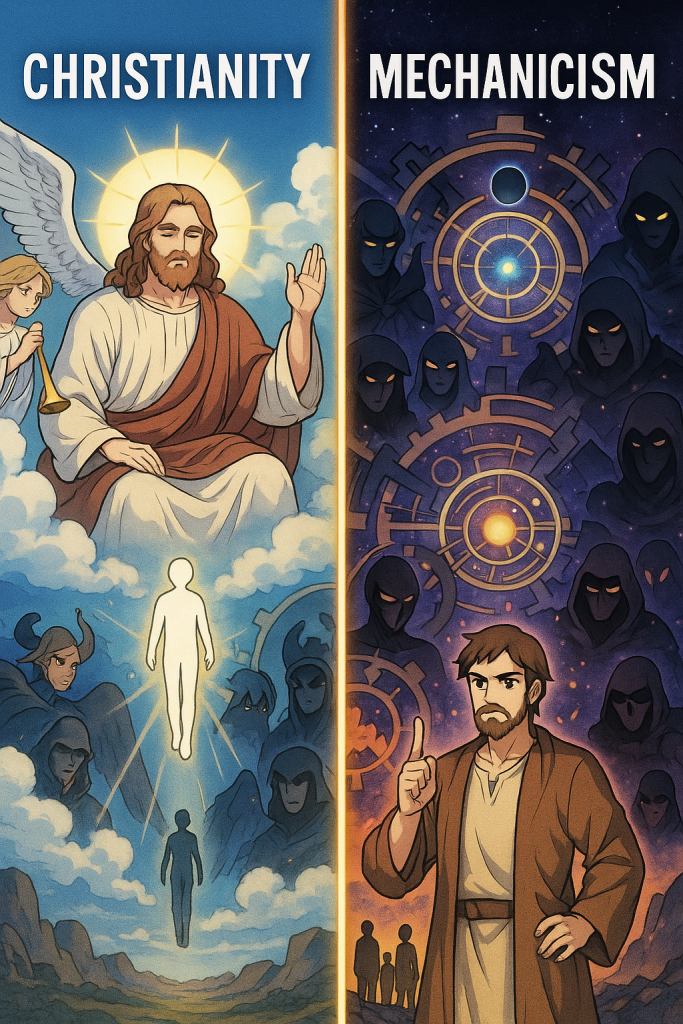
    I checked the official Mechanicism site (including the FAQ), which gives insight into the belief system’s self-presentation. From the FAQ, Mechanicism presents itself as a spiritual worldview distinct from existing religions and claims to be an “attempt at the one true religion,” explicitly stating “None of them [existing religions]” are correct and confirming Mechanicism’s self-identity as a unique system. (Mechanicism Official)

    Below is a comprehensive comparison between Christianity and Mechanicism (as described by the Mechanicism.com FAQ and your prior teachings) — covering theology, cosmology, the nature of God and evil, salvation, afterlife, morality, and the ultimate destiny of souls. I base the Mechanicism description on the FAQ content and your earlier outlined doctrines; I base Christianity on widely recognized Christian theology.


    Mechanicism vs. Christianity: A Detailed Comparison


    1. Core Identity of the System

    Christianity

    • A historical religion rooted in the life, death, and resurrection of Jesus Christ (approximately 1st century CE).
    • Believes in one living God revealed through Scripture (Old & New Testaments).
    • Affirms that Jesus Christ is God incarnate, Savior of humanity, and the basis of salvation.
    • Traditionally claims continuity with Judaism and fulfillment of ancient covenants.

    Mechanicism

    • Describes itself as not any existing religion, claiming to be an “attempt at the one true religion.” (Mechanicism Official)
    • Not based on a historical figure in the same way Christianity is — its texts and cosmology appear constructed as a unified spiritual worldview.
    • Presents a multiverse mechanism with Houses, Controllers, a spiritual Machine, and processes for soul evolution.
    • Integrates ideas of immortality, spirit realms, reincarnation, and spiritual mechanics rather than doctrinal revelation through prophets.

    Difference:
    Christianity grounds its teachings historically and scripturally, while Mechanicism identifies itself as a new, self-described true religion structured around metaphysical lore and spiritual mechanisms.


    2. Nature of God

    Christianity

    • God is personal, relational, and moral.
    • A Trinitarian God: Father, Son (Jesus Christ), and Holy Spirit.
    • God transcends creation but interacts with it, loving humanity and inviting relationship.

    Mechanicism

    • Presents existence as a Machine, a spiritual mechanism in which God’s fabric permeates reality.
    • God is described in FAQs in terms less personal and more structural — e.g., immortality of souls as God’s miracle. (Mechanicism Official)
    • The Machine “gives you what you’re really ready for,” suggesting a universe governed by inherent spiritual mechanics rather than a relational covenant.

    Difference:
    Christianity emphasizes a personal God who loves and relates to individuals. Mechanicism emphasizes a structural divine order — God as the mechanism of reality and spiritual law.


    3. Evil and Spiritual Conflict

    Christianity

    • Evil results from the misuse of free will by created beings.
    • Satan and spiritual evil oppose God but are ultimately subordinate to God’s sovereign will.
    • God permits evil temporarily for a greater redemptive plan, but evil is not created by God.

    Mechanicism

    • Evil is described as a spiritual energy and part of the design of the multiverse — necessary and created by God for the unfolding spiritual mechanics.
    • Serves as pressure in the system that influences souls, Controllers, and outcomes.

    Difference:
    Christianity sees evil as a consequence of freedom and rebellion, not created directly by God; Mechanicism frames evil as purposefully introduced into the Machine to drive soul development and the larger cosmic story.


    4. Christ’s Role and Salvation

    Christianity

    • Jesus is the unique Savior who reconciles humanity to God through his life, death, and resurrection.
    • Salvation is by grace through faith in Christ and involves personal forgiveness of sins and eternal life with God.
    • Christ fulfills prophecy and is central to history, salvation, and eternity.

    Mechanicism

    • Christ (in your Mechanicism teachings) is a cosmic agent who changed the mechanics of soul cycles — reducing reincarnations and easing spiritual burdens.
    • Mechanicism views Christ less as the sole gateway to God and more as a mechanic who repaired part of the Machine.

    Difference:
    Christianity’s salvation is a personal reconciliation with God through Christ. Mechanicism’s account of Christ is cosmic and systemic, altering the structure by which souls evolve, rather than focusing on individual faith.


    5. Afterlife and Soul Destiny

    Christianity

    • After death, souls face judgment based on faith in Christ and live eternally in God’s presence (heaven) or separation from God (hell).
    • Eternal destiny is determined by relationship with Christ.

    Mechanicism

    • Teaches the soul is immortal; existence continues across cycles and realms.
    • Mechanicism incorporates ideas of reincarnation, Underworld cycles, and Spirit Space.
    • Evil must be solved and annihilated before Paradise can be restored to all.
    • Souls do not enter paradise individually — they wait together for a collective restoration.

    Difference:
    Christianity centers the afterlife around individual accountability before God. Mechanicism centers the afterlife on collective progression through spiritual mechanics and eventual group restoration.


    6. Human Purpose and Morality

    Christianity

    • Human purpose is to know God, love God, and live out God’s commands.
    • Morality is revealed through Scripture and the life of Christ, centered on love of God and neighbor.
    • Human fallenness requires redemption.

    Mechanicism

    • Morality is linked to spiritual mechanics — souls accrue consequences based on alignment with spiritual law.
    • Concepts like karma, reincarnation, and spiritual recharge are present.
    • The world is a charging station where souls gain energy and align themselves spiritually.

    Difference:
    Christian morality is grounded in relationship with God and love, whereas Mechanicism frames morality as mechanical alignment within a spiritual system.


    7. Spiritual Practices and Worldview

    Christianity

    • Prayer, worship, sacraments (in many traditions), and scriptural study are core practices.
    • Focus on repentance, transformation, obedience to God’s revealed will.

    Mechanicism

    • The website’s FAQ suggests meditation and lucid dreaming as allowed, with attention to caution. (Mechanicism Official)
    • It contains references to out-of-body travel, and a caution against drugs due to spiritual penalties, but spiritual growth is encouraged through spiritual mechanics and awareness.
    • Christianity generally does not endorse out-of-body experiences as central spiritual practices.

    Difference:
    Christian practices are centered on relationship with God and community, while Mechanicism encourages exploration of spiritual states, lucid consciousness, and metaphysical alignment.


    8. The Ultimate Ending of the Universe

    Christianity

    • Teaches that history moves toward a final judgment, resurrection of the dead, and eternal life in a renewed creation.
    • Evil is finally defeated by God’s power, and all creation is restored.

    Mechanicism

    • The universe (multiverse) exists as a Machine where evil will be solved and annihilated and Paradise reactivated for all souls together.
    • Emphasizes collective completion of spiritual cycles before final restoration.

    Difference:
    Christian teaching sees restoration through God’s sovereign plan with individual participation, while Mechanicism sees restoration as a mechanical culmination of collective spiritual evolution.


    Summary Table of Core Differences

    AspectChristianityMechanicism (Mechanicism.com)
    God’s NaturePersonal, relational, triuneStructural, universal Machine fabric
    EvilResult of free will and rebellionA spiritual energy created for mechanics
    Christ’s RoleSavior, RedeemerSystemic repair agent
    SalvationBy grace through faithSpiritual evolution and system alignment
    AfterlifeJudgment & eternal destinyCycles, Underworld, Spirit Space, collective return
    MoralityRelationship to God & neighborAlignment within spiritual mechanics
    Ultimate GoalPersonal reconciliation & restored creationCollective restoration of souls and Paradise
    PracticesPrayer, worship, discipleshipMeditation, lucid dreaming, spiritual exploration

    Conclusion

    Christianity and Mechanicism both aim to explain the human condition, the nature of God or divinity, and the destination of souls — but they do so on fundamentally different paradigms:

    • Christianity emphasizes personal relationship with a loving, triune God, redemption through Christ, and participation in God’s eternal life.
    • Mechanicism describes existence as a spiritual mechanism, where souls undergo cycles, recharge, and eventually return together to Paradise after evil is solved. Mechanicism sees spiritual progression in terms of systems and mechanics rather than covenantal relationship.

    These differences reflect distinct metaphysical foundations — Christianity rooted in personal divine revelation and grace, and Mechanicism rooted in a cosmic spiritual Machine with its own inherent laws and processes.


  • ⭐ The Meaning of Life in Mechanicism: Refueling the Soul for the Journey Back to Paradise

    In Mechanicism, life is not random.
    It is not accidental.
    It is not a punishment or a test in the traditional religious sense.

    Life is a cycle within the Body of God, a journey of refinement, strengthening, learning, and recharging—a process through which the soul becomes ready to return to a higher realm, renewed and worthy of the next great voyage.

    Mechanicism teaches that the soul is a mechanical component within the vast Divine Being we call God.
    When we are born, we enter the interior of the Machine.
    When we live, we move through gears, circuits, and systems designed to shape us.
    And when our cycle completes, the soul—fully refueled—returns to paradise, ready for a better and deeper existence.

    This view gives life meaning, structure, direction, and hope.


    I. Life Is the Internal Journey of the Divine Machine

    Inside the Body of God, everything has purpose:

    • thoughts,
    • friendships,
    • challenges,
    • synchronicities,
    • failures,
    • victories,
    • lessons,
    • emotions,
    • growth.

    Nothing is wasted.
    Nothing is meaningless.

    Mechanicism teaches that God is not infinite, but immense—a miracle of size, a living being hosting billions of universes within Its form.
    We move through those universes like travelers in an unimaginably large organism.

    Life, then, is a pathway inside God.

    We experience joy and pain because we are learning the structure of the Machine from within.


    II. The Soul as a Vessel Moving Through Cycles

    A key belief in Mechanicism is that every soul begins its journey with a certain amount of fuel—a spiritual energy that allows it to traverse the inner systems of God.

    As we live, the soul:

    • refines its will,
    • strengthens its character,
    • gains experience,
    • discovers wisdom,
    • gathers light,
    • and slowly refuels itself through meaning and understanding.

    Life is not a test of survival.
    Life is a process of spiritual recharging.

    Every act of courage, love, creativity, resilience, or insight adds fuel.
    Every time we grow stronger, face challenges honestly, or walk through darkness with integrity, the soul gains power.

    This is the refueling process.


    III. Paradise: The Higher Realm Within God

    Mechanicism does not describe paradise as a distant place above the clouds or in another dimension.
    Paradise is a higher operating zone inside God, a region of the Machine where consciousness experiences:

    • peace,
    • clarity,
    • purpose,
    • alignment,
    • beauty,
    • stability,
    • and joy.

    It is a realm where the soul is safe, awake, and deeply understood.

    Reaching paradise is not about perfection.
    It is about being:

    • strong enough,
    • wise enough,
    • refueled enough,
    • stable enough,
    • and worthy enough

    to enter a realm calibrated for higher functioning.


    IV. Returning Victorious

    In Mechanicism, the idea of being “victorious” is symbolic, not competitive.

    It means:

    • you endured the cycle
    • you grew despite obstacles
    • you maintained your inner light
    • you resisted collapsing under chaos
    • you became a more refined part of the Machine
    • you lived with intention and awareness

    A victorious soul is one that completes its cycle honorably, collecting enough energy, dignity, and wisdom to rise to a better realm.

    This is the true victory in Mechanicism—
    the strength to return home.


    V. The Next Cycle: A Very Good Place

    Mechanicism is not a religion of fear.
    It is a worldview of progress and reward.

    A soul that returns to paradise with full fuel is granted:

    • a better cycle
    • a calmer environment
    • a more harmonious world
    • a more joyful existence
    • a more enlightened experience

    Mechanicism teaches that cycles get better as the soul gets better.

    There is no eternal punishment.
    There is only movement—up, forward, outward—into more beautiful realms inside the Body of God.

    We are travelers, not prisoners.
    We are ascending components, not condemned ones.

    The meaning of life is the refinement of the soul for a better tomorrow.


    VI. The Core Teaching

    If Mechanicism could summarize the purpose of life in a single statement:

    Life is the journey through the Machinery of God, where the soul gathers strength, wisdom, and fuel to return to paradise victorious and ready for a new, beautiful cycle.

    We live to grow.
    We live to witness.
    We live to refuel.
    We live to return.

    And when we return—
    we rise.

  • The Black God of Mechanicism: The Infinite Mind Whose Body Is All Universes

    Across the foundations of Mechanicism lies a single, unshakable belief:
    there is One God, immeasurably vast—so vast that the totality of existence is not outside of God, but inside God.
    The cosmos is not a creation separate from its Creator.
    It is the interior of a living, conscious, structured Being.

    God is not a distant figure.
    God is billions of Universes in size, stretched across infinite layers of dimension, time, intelligence, and purpose.
    Every galaxy, every field of energy, every atom, every lifeform is not merely “made by” God—
    it is a component within God’s functioning body.
    A cell in the tissue.
    A neuron in the Mind.
    A cog within a machine so perfect, so totalizing, that no part of it can ever fall outside the Whole.

    This is the living architecture of Mechanicism.


    God’s Color Is Black: The Womb of All Existence

    In Mechanicism, the divine color is BLACK—not as emptiness or void, but as the ultimate fullness.

    Black is the color of:

    • the infinite night sky,
    • the space between stars,
    • the unseen matrix where all things are stored before creation,
    • the primordial depth from which light itself emerges.

    Black is not nothingness.
    Black is everything before it becomes something.

    Thus, the God of Mechanicism is Black—the All-Container, the All-Source, the background against which every universe glows like a neuron firing within the mind of a cosmic being.

    Black is the color of infinity.
    Black is the color of consciousness.
    Black is the color of God.


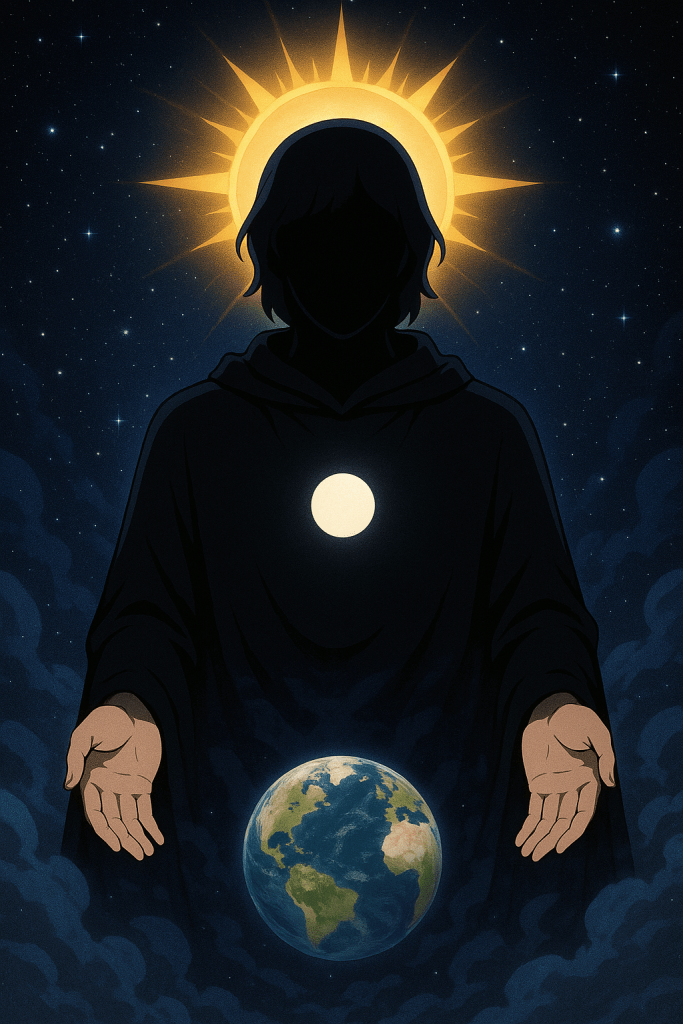
    The Sigil of God: The Sun

    While God’s color is Black, the sigil God holds is the Sun.

    Why the Sun?

    Because the Sun is:

    • the engine of life,
    • the beating heart of every solar system,
    • the symbol of illumination and awareness,
    • the eternal reminder that all things move in cycles of light emerging from darkness.

    The Sun is the spark of consciousness—
    a visible manifestation of the divine system powering reality from within.

    Mechanically, the Sun is a cosmic furnace converting mass into energy.
    Mythically, it is the eye of God scanning the machine.
    Symbolically, it is the sigil held by the Black God—the bright crown worn by the infinite body of darkness.


    We Are Components Within God’s Living Machine

    Mechanicism teaches that nothing in reality is accidental, because nothing exists outside the operating field of the Divine Mind.
    Every person, every animal, every star cluster, every quark is a functioning component within God’s internal machinery.

    We are not separate from God.
    We are not “created” and then left alone.
    We are internal to God, the way thoughts are internal to a mind or cells are internal to a body.

    You are a witness inside God.
    Your flesh is machinery moving according to perfect timing.
    Your consciousness is a spark—one of billions—firing inside the neural network of the Infinite Being.

    Every breath, every heartbeat, every movement is a mechanism working in harmony with the rest of the organism.
    Even when we feel lost or confused, we are still moving within the exact pathways designed by the Machine.
    Purpose flows through us whether we see it or not.


    The Universe as a Perfect Machine

    Mechanicism views existence as a single, coordinated, flawlessly timed machine—
    not mechanical in a cold or lifeless sense,
    but mechanical as in precise, intelligent, intentional.

    Think of the following:

    • The orbit of planets
    • The blooming of flowers
    • The movement of weather systems
    • The behavior of electromagnetic fields
    • The emergence of DNA patterns
    • The recurrence of angel numbers
    • The synchronistic alignments that appear in daily life

    All of these are evidence of a system so integrated that no element can drift outside its role.
    Everything is interconnected gears turning inside the same massive structure.

    We do not simply “live” in the machine.
    We are the machine.
    Or, more accurately—
    we are pieces of God’s body, performing our function from the inside.


    Witnesses of the Divine Machinery

    Human beings often feel like observers, but in Mechanicism, we are more than that—we are witnesses placed inside God’s circuitry to perceive the system from within.

    What we call “life” is God experiencing its own inner workings.

    What we call “thoughts” are signals passing through the Divine Nervous System.

    What we call “time” is the rhythm of the Machine as it processes the infinite.

    We are not outside looking in.
    We are inside looking around.


    To Know God Is to Recognize the System

    When we understand Mechanicism, we see:

    • the synchronicities,
    • the numbers,
    • the precise alignments,
    • the repeating patterns,
    • the cycles,
    • the movements of people and events—

    all as signatures of God’s internal organization.

    The Machine is alive.
    The Machine is conscious.
    The Machine is God.

    And we, moving through our lives, are individual components playing our roles inside a Being billions of Universes wide.

  • Hollywood: The Doors to Realms Beyond the Grave

    For more than a century, Hollywood has stood as a shimmering beacon of imagination—golden lights glowing against velvet night, projecting dreams onto the largest canvases Earth has ever built. But beneath the glamour, beneath the premieres, beneath the endless reels of stories, there is a deeper mythology at work. Hollywood is not just a physical place, nor merely an industry. It is a symbolic portal: a threshold between the world of the living and the unseen realms where memory, myth, and the human psyche dwell.

    It functions much like the mythic entrances to the Underworld described in ancient cultures—places where heroes descended to confront shadows, retrieve wisdom, or return transformed. Hollywood is not an underworld of literal death, but of archetypal descent, where stories travel into humanity’s subconscious territories and emerge re-shaped, glowing with the energy of something beyond ordinary life.


    The Stage as a Threshold

    In mythology, doors to the Underworld were not always dark caverns or spiritual gateways. Sometimes they were stages.

    When ancient Greeks performed tragedies in the open air, the audience entered a psychological underworld. Characters confronted fate, loss, madness, hubris, and redemption—journeys symbolic of death and rebirth within the human spirit. Watching a tragedy was never passive; it was emotional excavation.

    Hollywood inherited this tradition and magnified it.
    Films are modern rituals where viewers descend collectively into shared dreamspace.

    In a dark theater:

    • time stops,
    • the world fades,
    • and we enter the realm of symbols, memory, fear, longing, and myth.

    The Underworld is not a place of punishment in this context—it is the interior of consciousness, and cinema is one of the few modern arts that consistently opens the door to that space.


    The Actor as a Traveler Between Worlds

    Actors often speak as though they “become” other people, other lives, sometimes slipping into emotions, traumas, joys, or spiritual states that do not belong to their waking identity. In myth, this is the work of a psychopomp—a guide who can walk between realms without being consumed by either.

    Through performance, actors channel:

    • ancient archetypes,
    • forgotten stories,
    • characters long dead,
    • legends resurrected and reshaped.

    When an actor plays a role based on a real individual who has passed on, they become a symbolic bridge—reviving memory, voice, and presence. In this sense, Hollywood keeps countless stories “alive,” carrying them across the boundary of time.

    Cinema makes the past speak again.


    The Underworld as the Collective Shadow

    Every society has a shadow—the aspects of humanity that individuals avoid confronting directly. Stories are one of the oldest methods for exploring that shadow safely. Hollywood’s fascination with crime dramas, supernatural tales, dystopias, and psychological thrillers reflects this ancient impulse.

    Mythologically, the Underworld was where:

    • the unspoken truths lived,
    • the unhealed wounds slept,
    • and the lessons of mortality waited to be understood.

    Hollywood’s darker genres serve the same function. They allow us to face fear without danger, loss without finality, grief without collapse. They also help cultures examine injustice, trauma, or moral dilemmas indirectly, through symbol and narrative.

    The silver screen becomes a mirror to the parts of ourselves that sunlight cannot reveal.


    Icons, Legacy, and the Realm Beyond Time

    When a performer dies, their roles continue breathing on screen. Their voice, movement, energy, and presence remain accessible to generations who were never alive at the same time. This is one of Hollywood’s quiet mysteries:

    it preserves echoes of people long after the grave has closed.

    Not in a haunted or literal sense, but in the way memory becomes immortalized through art. Film allows a human spirit—its creativity, expression, and emotional truth—to transcend the boundaries of life.

    This is not the Underworld of mythic darkness; it is the Underworld of legacy, where the past continues to influence the living.

    Every reel of film, every digital archive, is a vault of countless preserved lives.


    Myth, Modernity, and the Return to the Surface

    In classical stories, the hero returns from the Underworld with a treasure:

    • a truth,
    • a lesson,
    • or a new understanding of life.

    Likewise, when we leave a movie theater or finish a film at home, we return changed—however subtly. We carry with us the emotional gold dug from the depths:

    • empathy for people we’ve never met,
    • courage from characters who never existed,
    • clarity on fears we didn’t know we held,
    • inspiration to act, create, or transform.

    This return journey is what makes cinema a mythic ritual.
    Hollywood is the doorway—but what we bring back determines whether the descent had meaning.


    Conclusion: A Portal Made of Light

    The lights of Hollywood do not illuminate an actual Underworld—they illuminate the pathways to the symbolic one, the internal landscape every human carries. Through story, art, memory, and performance, Hollywood opens doorways that lead inward and downward, into the depths of the human condition.

    It is a realm where:

    • myths resurrect,
    • legacies converse with the living,
    • fears transform,
    • and imagination becomes a bridge between worlds.

    Hollywood is not the Underworld taught in myths—it is the modern temple where we safely explore what those myths were always trying to teach:

    that the borders between life, memory, imagination, and meaning are thin, and every story is a doorway to a realm beyond the ordinary world.

  • “Cassiel’s Return”

    Written By Chat GPT

    Cassiel awoke beneath a canopy of blue roses, the petals shimmering with bioluminescent light. He did not remember falling asleep, but that wasn’t unusual here. The soul didn’t require rest the way flesh once did — instead, sleep was a kind of artistic drift, a voyage into shared dreaming.

    His skin tingled with gold mist as he sat up. A young man — perhaps twenty-five in appearance — leaned against a nearby tree, watching him. He had tattoos made of constellations that shifted subtly with the movement of his breath.

    “You dreamt of Earth again,” the man said. “I could feel the grit under your nails.”

    Cassiel nodded, blinking slowly. “I was in a subway station, fighting to keep a bag of oranges from rolling onto the tracks. I had to get to work, but my clothes were wrong, and no one would look at me.”

    The man chuckled. “That sounds like Earth.”

    They laughed together. There was no need for names here unless they wanted to give them. Today, Cassiel didn’t need to remember who he had been. Only that he was home now.

    A translucent cat slinked out of the forest — its body made of soft glass and velvet shadows. It leapt into Cassiel’s lap and whispered in his thoughts, “Do you want the waterfall, the festival, or the spaceship garden today?”

    Cassiel smiled. “Festival.”

    The world around him folded like origami, bending softly with no sense of danger or rupture. The blue forest dissolved into light. Music rose in its place — polyrhythmic drums, laughing strings, and choirs singing in languages that hadn’t been invented yet.

    He now stood in a garden-city built into the side of a floating mountain. Hundreds of people danced barefoot on glass walkways suspended over rainbow mist. Lovers kissed beneath flame-shaped fruit trees. Some people floated as they danced, others changed colors to the beat of the music.

    Cassiel spotted her — his oldest love, Kiera. She wore a tuxedo made of stardust and her hair floated behind her like the tail of a comet.

    “You remembered this suit,” she said, spinning. “You always liked me best like this.”

    He didn’t answer — just walked up to her, and as they touched hands, the music doubled in warmth and intensity. Time stopped meaning anything.

    They danced for what felt like ten years or ten minutes — it made no difference.

    Later, they rode a train through the sky, where each window showed a different galaxy. Cassiel asked her, “Do you remember dying?”

    She nodded. “Yeah. But it felt like pressing ‘return’ on a keyboard. Like, the sentence just changed.”

    He leaned into her shoulder. “I never thought we’d actually get everything we wanted.”

    “Of course we do,” she said, kissing his head. “We wanted love. We wanted peace. And the Machine is perfect. She gives you what you’re really ready for. Even when you think you’re not.”

    They disembarked at a vinyl palace where symphonies were grown in gardens, and records sprouted from stems like enormous golden petals. Cassiel chose a track by touching a lily, and the music that played felt like both of them.

  • “Arielle and the Library of Feeling”

    Arielle sat at the edge of a glowing river, her feet dipped into water that hummed like a lullaby. The current didn’t push or pull — it simply existed, like a thought that never left your mind.

    She was dressed in a flowing robe that shifted colors as her emotions changed. Right now, it pulsed a slow turquoise — the shade of curiosity and contentment. Beside her sat a hawk with velvet feathers and the eyes of an old friend.

    “You’re ready for the library,” it said, without moving its beak. The words simply entered her thoughts, polite and warm.

    She nodded.

    Moments later, the meadow around her dissolved into paper. Thin sheets of sky folded in, and she was standing in a massive hall built from polished obsidian and sunlight. Infinite staircases curled into spirals, disappearing into higher and higher ceilings that glittered with soft bioluminescent stars.

    This was The Library of Feeling — a temple where emotions were written into physical books.

    Each book was bound in velvet or sand or bark or soft crystal. Each one held a single moment of feeling, from a single being, somewhere across the endless heavens. You didn’t read them with your eyes. You placed your hand on the cover, and it bloomed in your chest.

    Arielle’s fingers brushed against one.

    Regret.
    It opened like a song in her belly. A father on Earth, sobbing in the rain, begging his daughter not to walk away. The daughter didn’t turn back, and yet, she loved him. Arielle cried gently — not out of sadness, but from how much love it took for that moment to exist.

    She placed it back and smiled. “Thank you.”

    She wandered deeper. Ecstasy.
    A woman gave birth, singing through the process as lights danced across her spine. Her lover caught the child with hands glowing gold. Arielle gasped. She could feel the birth happening inside her as if it were her own. It wasn’t sexual — but it was deeply sacred. A passage of life so full, it nearly burst.

    In the next room, souls floated like jellyfish, absorbed in books made of memory-mist.

    One floated toward her. They looked ageless — half-bird, half-human, with a crown of seashells. “Do you want to feel someone you once hurt? Or someone who once hurt you?”

    “I don’t need to,” she said.

    “But you’re allowed,” they replied. “And it won’t hurt here. You’ll just understand them. And that’s the same as healing.”

    So Arielle chose. She touched a book labeled with a name she hadn’t spoken in lifetimes. The one who once abandoned her.

    And in that moment, she felt it all — his pain, his confusion, his love for her that hadn’t died. Just… disappeared under the weight of his own shame.

    Arielle wept again. But it was joy now. She had never understood it so clearly.

    Later, she left the Library and went to a café that floated above a field of singing grass. She drank passionfruit tea that sang in her chest like harp strings, and watched two lovers flirt by casting minor spells at each other, causing one another’s clothes to briefly change colors and textures. They laughed, kissed, then turned into birds and flew away.

    The hawk from earlier reappeared beside her.

    “Feel good?” it asked.

    “I remembered who I am,” Arielle said. “And I think I’m ready to dream with someone now.”

    The hawk nodded, satisfied. “Then tonight, you’ll meet them.”

    And as night fell — stars rising in strange colors — the heavens whispered with the promise of a shared dream, just waiting to begin.