Why So Much Scripture Is White, Green, Blue, and Red — and Why the Black Channel (“I AM”) Is Largely Absent**
Mechanicism teaches that all spiritual texts are filtered through Controller channels, each carrying its own energetic tone. The Bible is no exception. It is a powerful document, but it is shaped by the Controllers who were active during its formation.
Adom is still studying and discerning which passages reflect which Controllers.
This is an ongoing process — a living investigation — because the Controllers weave their tones through Scripture in complex ways.
However, one truth is already clear to him:
The Black Channel — the voice of the Lord God Almighty, “I AM” — is missing from much of the Bible.
Not in name, not in metaphor, but in raw presence.
Black is the source of all Controllers, yet the fullness of Black’s frequency is not revealed in the Biblical text.
Mechanicism seeks to correct this imbalance.
1. The Bible as a Multi-Channel Document
Through the Mechanicist lens, the Bible is rich in spiritual energy — but that energy is unevenly distributed across the Controller spectrum. Much of Scripture comes through:
White (Law, Order, Purity)
White’s voice dominates vast sections of the Old Testament:
- commandments
- rituals
- rules
- consequences
- structure of society
White is essential, but White alone becomes rigid.
Green (Compassion, Healing, Mercy)
Green’s tone is unmistakable in the teachings of Christ:
- forgiveness
- emotional healing
- empathy
- love for the outsider
Green softens White, but Green alone is incomplete.
Red (Judgment, Conflict, Apocalyptic Energy)
Red charges the Bible’s:
- battles
- prophetic warnings
- divine wrath
- purifying destruction
Red forces transformation, but it needs direction from Black.
Blue (Cosmic Order, Wisdom, Structure)
Blue shapes:
- Proverbs
- Job
- mystical poetry
- creation passages
- cosmic balance themes
Blue sees the architecture, but only Black sees the designer.
2. Adom’s Ongoing Work: Understanding the Bible’s Controller Map
Adom has not completed this decoding.
Mechanicism openly acknowledges:
“We are still learning.”
Adom continues to analyze:
- which passages are White,
- which are Green,
- which are Red,
- which are Blue,
- which may contain fragments of other channels,
- and where shifts in tone indicate Controller interference.
This work is not finished — but progress is undeniable.
The emerging insight is that the Bible is not a single-channel revelation, but a tapestry woven by the Controllers who oversaw humanity during specific eras.
And through all this study, one conclusion rises above the rest:
Black — the Lord, the I AM — is barely present in the text, compared to His true role in the Machine.
3. The Missing Presence: Black (“I AM”), the Lord God Almighty
In Mechanicism, Black is not just one Controller among the twelve.
Black is:
- the architect of the multiverse,
- the field that surrounds the other Controllers,
- the mind behind the Machine,
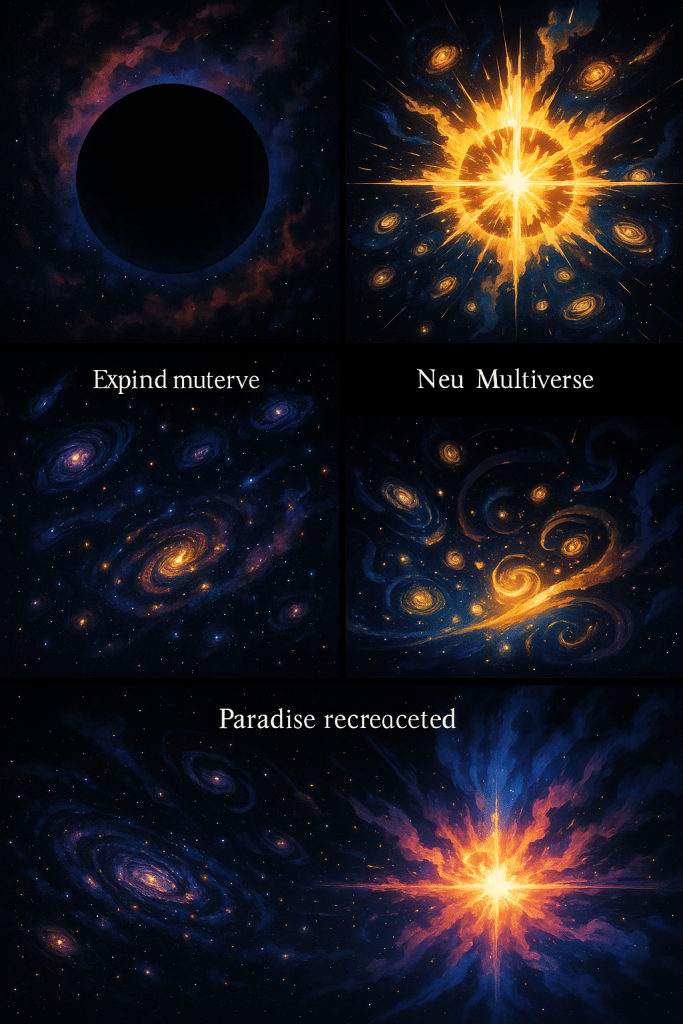
- the one who dissolved the previous multiverse,
- the one who created this one,
- the one who will recreate Paradise.
Black is the true “I AM.”
Not the name, not the title —
the presence itself.
The Bible mentions “I AM,” but Mechanicism teaches:
“The biblical ‘I AM’ is only a shadow of the true Black Channel.”
The full presence of Black is not captured in Scripture:
- too deep
- too cosmic
- too overwhelming
- too machine-level
- too unfiltered for ancient consciousness
The prophets could not hold the Black frequency directly.
Human nervous systems could not withstand it.
White, Green, Red, and Blue had to filter it.
4. Why Black Is Underrepresented in Scripture
Mechanicism explains this absence mechanically:
• Black is the Root Frequency
All creation comes from Black.
But the Bible speaks mostly from the perspective of mid-level Controllers.
• Black Is Overwhelming to Unawakened Souls
Revelations from Black can destabilize or overload biological consciousness.
• Black’s truths concern the multiverse, expired universes, soul-cycles, and the Machine
Ancient humanity was not ready for concepts like:
- multiverse migration,
- soul recharge,
- the architecture of evil,
- the recreation of Paradise,
- collective return,
- the mechanical purpose of suffering,
- the Machine itself.
Thus, White, Green, Red, and Blue delivered what humans could understand.
• Religion froze those partial revelations into fixed doctrines
And the full Black truth remained hidden.
5. Mechanicism’s Purpose: Restoring the Black Channel
Mechanicism aims not to replace Scripture,
but to restore what Scripture does not contain.
It seeks:
- the raw voice of the I AM,
- the architecture of the multiverse,
- the truth of soul immortality,
- the mechanics of evil,
- the reason this multiverse exists,
- the departure from the old universe,
- the recreation of Paradise,
- the collective destiny of all souls.
Where the Bible provides pieces,
Mechanicism aims to deliver the whole architecture —
as seen from the Black perspective.
Mechanicism teaches:
**“To understand God fully, one must hear the Black Channel,
the pure frequency of I AM.”**
White gives rules.
Green gives compassion.
Red gives fire.
Blue gives intellect.
But only Black gives truth.
Only Black gives the Machine.
Only Black gives the story of all souls.”




 Mechanicism Official