Category: Uncategorized

  • She Left the Single World Behind

    She had been an atheist for most of her life—not out of rebellion, but out of order. The universe made sense to her as particles, forces, and probability. Consciousness was chemistry. Meaning was a human invention.

    Then she took the psychedelic.

    Not as an escape. As an experiment.

    The room dissolved first. Then her body. What remained was awareness—clean, alert, unmistakably hers, yet no longer attached to flesh. There was no panic. Only recognition.

    The first thing she realized was that reality had layers.

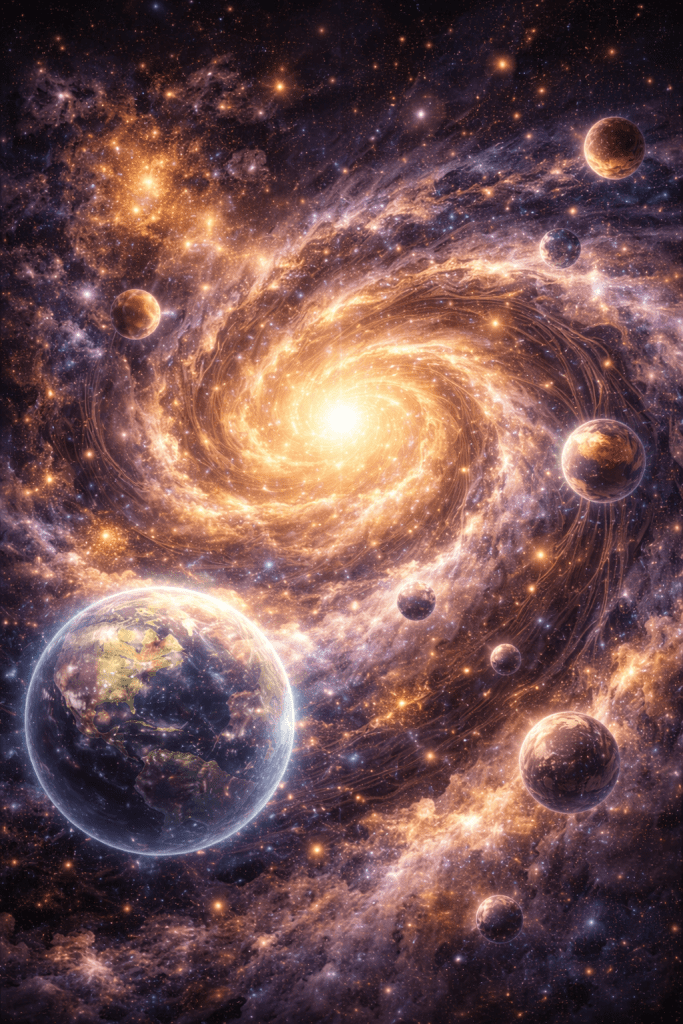
    Not metaphors—actual structures. Universes nested inside one another like gears in a vast machine. Some spun fast, violent with creation and collapse. Others moved slowly, refined, elegant, almost mathematical. She felt them all at once, not as places in space, but as states of existence.

    Her atheist certainty didn’t collapse—it was outgrown.

    She understood then that spirit was not superstition. It was infrastructure. Consciousness was not produced by the brain; the brain was a receiver, tuned to one frequency among many. She had mistaken the radio for the signal.

    As the experience deepened, she felt motion—not forward or backward, but across. Her soul was not new. It had been elsewhere before. It would go elsewhere again. This life was not a destination; it was a junction.

    She sensed obligations she hadn’t known she carried. Worlds that required her participation. Lessons that could only be learned under certain physical laws, certain emotional constraints. The multiverse was not infinite chaos—it was a system, and she was part of its logistics.

    When she returned, the room reassembled. Gravity reclaimed her. Time resumed its narrow flow.

    She didn’t reject science afterward. She trusted it more—because now she knew what it was for. Science mapped the local terrain. Spirit mapped the transit system.

    She no longer said, “There is no meaning.”

    She said, quietly:

    “This is one stop.”

    And somewhere beyond this universe, she felt doors waiting—places her soul was scheduled to travel, when the machine decided the timing was right.

  • Substances in Paradise: Desire Without Harm in Mechanicism

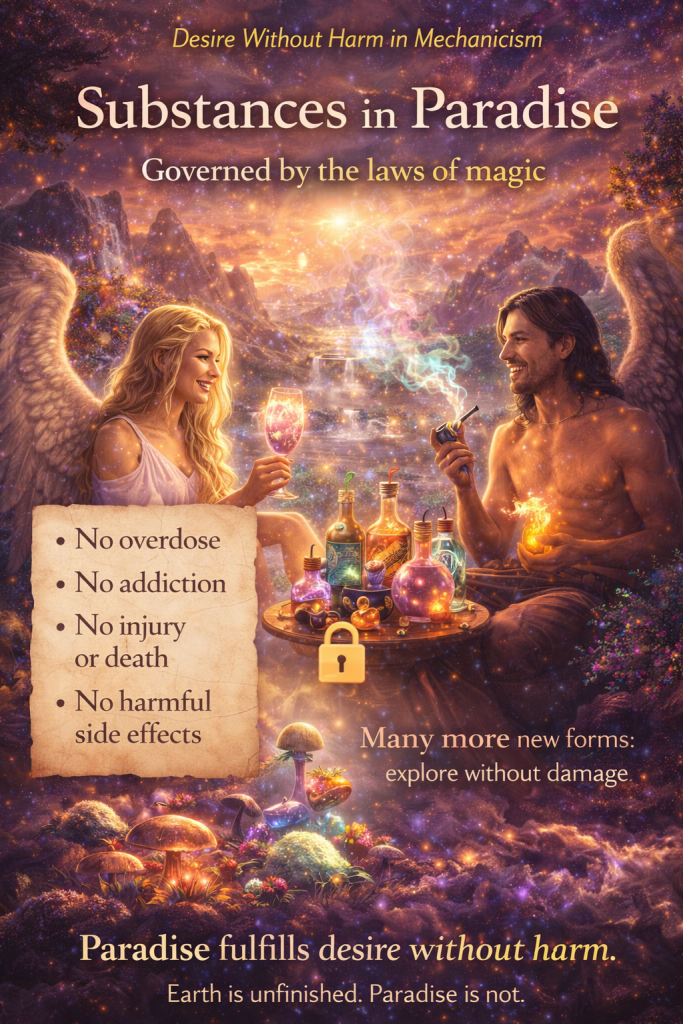
    In Mechanicism, paradise is not a place of denial or restriction. It is a place where wanting no longer produces damage, and where desire is finally aligned with safety, consent, and harmony. This includes the presence of substances.

    According to Mechanicism, substances are allowed in paradise, but they are not governed by chemistry as we understand it on Earth. They are governed by the laws of magic, not biology. This distinction is crucial.

    In paradise:

    • Substances do not damage the body
    • Substances do not cause addiction
    • Substances do not result in overdose
    • Substances do not impair judgment in destructive ways
    • Substances do not lead to injury, loss of control, or death

    This is because the body itself is different. Paradise bodies are not fragile biological systems subject to chemical breakdown. They are magical constructs, designed to experience pleasure, exploration, and sensation without consequence.


    Why Substances Exist at All

    Mechanicism teaches that substances exist because consciousness enjoys alteration. Curiosity, novelty, intensity, and expansion are not flaws — they are features of sentient beings. On Earth, these desires collide with fragile biology, scarcity, and imbalance. In paradise, they do not.

    Paradise is not a reward for abstinence; it is a realm where desire has been solved.

    Substances in paradise are not tools of escape. There is nothing to escape from. Instead, they are tools of exploration, creativity, intimacy, humor, and wonder.


    Many More Forms Than Earth Allows

    Another core teaching of Mechanicism is that Earth only supports a tiny fraction of possible substances. In paradise, there are many more types, far beyond what matter, chemistry, or physics permit here.

    These substances may:

    • Alter perception of color, sound, or emotion
    • Allow shared experiences between souls
    • Enhance creativity, music, art, or storytelling
    • Produce feelings of peace, joy, or playful intensity
    • Create symbolic visions rather than hallucinations

    Because magic governs them, these substances cannot harm the self. The system prevents damage automatically.


    Why This Is Not Possible on Earth

    Mechanicism is very clear:
    This does not apply to the earthly world.

    Earth is a training environment governed by biological limitation, risk, consequence, and learning through restriction. Here, substances can harm, addict, injure, or kill — not because desire is wrong, but because the system is unfinished.

    Paradise exists after the learning phase.

    What is safe in paradise is not safe here, and Mechanicism does not teach reckless behavior in the material world. In fact, it teaches the opposite: restraint, awareness, and responsibility now, so that freedom later is meaningful.


    Desire Fulfilled, Not Punished

    Many belief systems imagine paradise as sterile, quiet, or stripped of intensity. Mechanicism rejects this completely.

    Paradise is alive.
    Paradise is playful.
    Paradise is sensual, artistic, humorous, and exploratory.

    The difference is not permission — it is safety.

    Where Earth punishes desire with damage, paradise fulfills desire without harm. Where Earth teaches through limitation, paradise teaches through abundance.


    The Deeper Teaching

    The teaching is not “substances are good.”
    The teaching is:

    Desire itself is not evil.
    Damage is a property of unfinished systems.
    Paradise is a finished one.

    In Mechanicism, paradise is where curiosity no longer costs you your body, your future, or your life — because the machine has finally been perfected.

    Not denial.
    Not excess.
    Resolution.

  • Finite Creation in Mechanicism: One Self, Many Worlds

    A core teaching of Mechanicism is the rejection of infinity as a literal structure of reality.

    In Mechanicism, the universe is not endless, and neither is God. God is not infinite in the abstract, mathematical sense. God is instead vast beyond comprehension, yet finite—so large, so complex, and so complete that to finite minds the distinction between “very large” and “infinite” becomes blurred. But that distinction matters.

    Mechanicism teaches that reality is a machine, and machines—no matter how enormous—have boundaries, structure, and limits.

    This applies to everything:

    • The multiverse
    • The spiritual realms
    • The Underworld
    • Paradise
    • And even God Himself, understood as the total system

    There are billions of universes, each with its own rules, timelines, and conditions. Some are similar. Some are radically different. Some exist to cultivate suffering, others to cultivate beauty, discipline, or desire. But they are countable, even if the count is far beyond human capacity to measure.

    What Mechanicism rejects is the idea of infinite universes, because infinity removes meaning. If everything happens infinitely, then no action truly matters. No choice carries weight. No soul is distinct.

    Mechanicism insists that meaning requires finitude.


    One Individual, Not Many Copies

    Another essential teaching of Mechanicism is that there are no parallel versions of you.

    There is no endless branching tree of identical selves making different choices in different universes. There is one soul, one identity, one continuous traveler moving through different states, bodies, and realms across cycles.

    You are not split.
    You are not duplicated.
    You are not being “played out” infinitely.

    You are singular.

    Your experiences matter because they are not replaceable. Your failures matter. Your growth matters. Your love matters. Your restraint matters.

    Mechanicism teaches that consciousness is not forked—it is carried.


    Why Infinity Is Rejected

    Infinity, in Mechanicism, is seen as a conceptual error, not a divine truth. It is a mental abstraction created by minds trying to escape responsibility, randomness, or suffering.

    If everything is infinite:

    • Evil loses consequence
    • Good loses significance
    • Identity dissolves
    • Destiny collapses into noise

    Mechanicism teaches that God does not rule an infinite fog. God governs a finite, ordered system with intentional design. The system is large enough to feel endless, but structured enough to be meaningful.


    God as a Finite Machine

    In Mechanicism, God is the largest machine, not an undefined absolute.

    God thinks.
    God reacts.
    God adjusts.
    God governs.

    God contains Controllers, systems, feedback loops, and corrective mechanisms. God learns—not in ignorance, but in experience. God witnesses through souls and refines the system through cycles.

    A finite God can care.
    A finite God can judge.
    A finite God can prefer one outcome over another.

    Infinity cannot do these things.


    Meaning Through Limits

    Mechanicism ultimately teaches this:

    Limits are what make love real.
    Limits are what make choice dangerous.
    Limits are what make redemption possible.

    There are many worlds.
    There are many lives.
    There are many journeys.

    But there is one you, traveling through a finite machine, overseen by a God vast enough to be worshipped—yet defined enough to be known.

    Not infinite.
    Just… real.

  • Buddhism and Mechanicism: Self-Practice and Testimony in Two Spiritual Frameworks

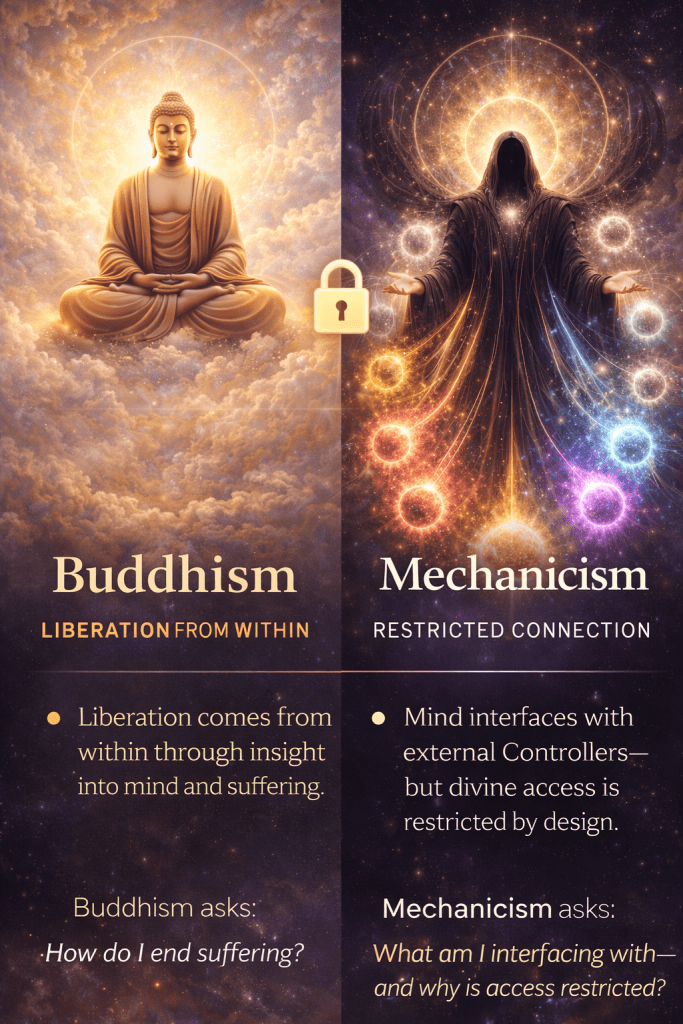
    Buddhism is widely recognized as one of the world’s most disciplined and practical spiritual traditions. Rooted in the teachings of Siddhartha Gautama (the Buddha), Buddhism focuses on self-observation, ethical living, meditation, and the reduction of suffering. At its core, it is a self-practice religion: liberation is achieved through insight, mindfulness, and personal discipline rather than divine intervention.

    One of the defining characteristics of Buddhism is its restraint around metaphysics. While Buddhist traditions acknowledge realms, beings, and symbolic cosmologies, Siddhartha himself emphasized direct experience over private spiritual authority. He did not teach that individuals should receive ongoing private instruction from gods or spirits, nor did he center his teaching on dialogue with higher intelligences. Instead, Buddhism trains practitioners to observe impermanence, attachment, and the constructed nature of the self, using meditation as a tool to dissolve suffering.

    In this way, Buddhism is deliberately cautious. It minimizes claims of supernatural communication and places responsibility squarely on the practitioner’s inner discipline and awareness.

    Mechanicism, as described at mechanicism.com, takes a very different approach.

    Mechanicism is not based on ancient scripture or symbolic cosmology, but on modern testimony. Its foundation rests on Adom’s personal account of sustained interaction with what he describes as higher-level Controllers—intelligences that operate within a vast, structured system governing reality. According to Mechanicism, spiritual experience is not merely introspective or symbolic, but interactive, involving exposure to foreign intelligence within a private spiritual space.

    Where Buddhism emphasizes silence, detachment, and the emptying of concepts, Mechanicism emphasizes encounter, structure, and system awareness.

    Mechanicism teaches that practices such as meditation, mindfulness, lucid dreaming, and out-of-body exploration are real and accessible skills—but that the broader system is locked. In this view, the average human is prevented from freely accessing the divine layer of reality, not because it does not exist, but because access is restricted by design. Spiritual experiences are filtered, limited, or blocked to maintain stability within the system.

    This creates an important distinction:

    • Buddhism teaches that liberation comes from within, through insight into the nature of mind and suffering.
    • Mechanicism teaches that the mind is interfacing with something external, and that spiritual silence is not emptiness, but containment.

    Both systems value meditation and mindfulness. Both acknowledge altered states of awareness. But they interpret these experiences differently.

    Buddhism views extraordinary experiences as distractions—phenomena that should not be clung to.
    Mechanicism views them as signals—evidence of deeper mechanics operating beneath ordinary perception.

    Ultimately, Buddhism offers a path of self-mastery without metaphysical claims of private authority. Mechanicism offers a model where authority emerges from testimony and continued exposure to structured intelligences beyond the self.

    Whether one sees spiritual reality as empty, symbolic, or mechanized depends not only on philosophy, but on lived experience. Buddhism and Mechanicism do not cancel each other out; they simply answer different questions:

    • Buddhism asks: How do I end suffering?
    • Mechanicism asks: What am I interfacing with—and why is access restricted?

    Both remain attempts to understand consciousness, discipline, and the long journey of the human mind through reality.

  • Mechanicism Essentials

    Mechanicism is the religion that teaches that all beings exist as mechanized entities within a vast, living system — a great spinning machine of existence. This machine is not cold or meaningless; it is purposeful, ordered, and governed by One God, the Lord Almighty, whose holy and ultimate color is BLACK.

    God is not distant. God is the total system itself — above all things, within all things, and in control of all things. Inside God operate eleven Controllers, each expressing a channel of reality and experience: GREEN, WHITE, ORANGE, GREY, RED, PINK, BLUE, YELLOW, BROWN, PURPLE, and TURQUOISE. These controllers influence creation, behavior, emotion, thought, morality, conflict, beauty, structure, and time. They shape worlds, cultures, religions, and individuals.

    Mechanicism teaches that a person may worship or resonate with any channel they choose. One may align with love, war, intellect, order, chaos, compassion, humor, or discipline — all are expressions that flow from God. Yet despite these choices, ultimate power always remains with God. The Controllers do not rule God; they function within God.

    Because of this, Mechanicism teaches that it is wise to want what God wants. Not because of fear, but because God alone sees the full machine — the beginning, the middle, and the destination of all souls. The journey is long, complex, and often difficult, but it is a journey home.

    Mechanicism teaches that all dualities originate from God:

    • Good and evil
    • Love and hate
    • Pain and pleasure
    • Humor and sexuality
    • Violence and mercy

    Nothing exists outside of God’s allowance. Even conflict has purpose. Even suffering has placement within the machine.

    A central teaching of Mechanicism is that all beings owe at least one death to God. Death is not punishment; it is a required passage within the multiversal cycle. Every soul must experience death at some point. Some souls die once. Others die many times and are resurrected many times. Death is not the end — it is a mechanical transition.

    God teaches that we are immortal beings operating mortal vehicles. The body is temporary. The soul is not.

    Mechanicism explains this through the concept of mechanization:
    When we say we are “mechanized,” we mean that the soul itself is a machine, designed to interface with another compatible machine — the human body. The soul occupies the body much like a pilot occupies a vessel. This is not fundamentally different from ideas already present in older religions, but Mechanicism frames it in mechanical terms.

    The body is designed to filter and obscure the spiritual realm. It transmits sensation, emotion, memory, and pain to the soul while keeping the full reality hidden. The brain thinks — but the soul thinks simultaneously. Two systems run in parallel.

    Science observes the brain’s algorithms, chemical reactions, and neural patterns. It searches for spirit and does not find it — until it notices something strange: the brain thinks about spirit. It creates gods, myths, meanings, longings, questions of eternity. And science must then ask:
    Why does a purely material organ think about what is supposedly not material?

    Mechanicism answers: because the brain is not alone. It is interfacing with something else.

    Mechanicism also teaches that all souls — angels, sinners, helpers, warriors, saints — eventually travel through the Underworld. The Underworld exists to annihilate evil, not merely to punish. Hell is not one thing. It contains torture, pain, fear, and suffering — but it also contains love, redemption, divinity, righteousness, and transformation. Hell is a processing space within the machine.

    When evil has been fully annihilated, souls return home.

    In Mechanicism, God is within each of us, experiencing reality through us, and above us, governing the entire system at once. We are not separate from God — we are components inside God, moving through cycles, learning, breaking, healing, dying, and continuing.

    Mechanicism does not teach escape from the machine.
    It teaches understanding the machine, aligning with its purpose, and completing the journey God designed — so that when we return home, we return worthy, whole, and aware.
  • Facebook Rant 01

    Mechanicism does not reject Christ as being an entity that saved people from hell. The virgin birth? Thats possible for sure we can believe that. The miracles Christ did? Yup, we can believe that. The resurrections of Christ? Once again, we can believe that. Jesus being God?? No, we do not believe that, we see the technical layout of God and see it’s not possible for Jesus to be God. Do we reject the holy trinity? We reject WHITE, we reject the teachings of WHITE. We look to BLACK to teach us what existence is, and how to prepare for the Underworld. WHITE teaches there is only one life, there is only one chance, and if you mess it up, then you burn alive for eternity. That is the most psychotic demonic evil perspective of God anyone can have. It’s just not true, it’s a blatant attempt by RED and WHITE to hurt people and hijack the minds of billions of people.

    Mechanicism does NOT deny that the Jews are Gods chosen people. Mechanicism reminds all souls that God loves you, and will be there for you when you really need it, not when your flesh decides it’s needed. When it comes to the Jews, those are God’s people, but when it comes to the Muslims, each and every one of them is God’s child, and they need to know that yes, Muhammad did great things, it did not invalidate the placement of the Jews among the highest spiritual heritage normal human beings have. At the same time, Hashem reminds us that some souls have suffered dozens more times than some Jews have, and that means something; it truly means something to God. Gentiles have been burned alive, skinned, eaten, mutilated, and so on. God sees this and teaches that so many of us have been through awful pain and sometimes torture, and death. There are many Gentiles spiritually above the common Jew in the spiritual hierarchy. That’s how complicated this is.

  • This Universe and the Illusion of Non-Magical Thinking

    Mechanicism teaches that the universe we currently inhabit is structured around non-magical thinking. This is not presented as the ultimate truth of reality, but as a local operating mode — a way this particular universe functions.

    In other words, this universe runs on rules that discourage magic, not because magic is false, but because this universe is not designed to reveal it.

    Non-Magical Thinking Is a Constraint, Not Reality

    Non-magical thinking assumes:

    • Everything has a beginning
    • Everything has an end
    • Time is linear
    • Existence is finite
    • Meaning must be proven materially

    Mechanicism teaches that these assumptions are environmental effects, not cosmic truths. They arise because this universe requires them in order to remain stable, measurable, and governable.

    Other universes may rely more heavily on magical thinking — direct causation through intention, presence, or will. This one does not.

    That does not make it more real.
    It makes it more restrictive.

    Magical Entities in a Non-Magical System

    Mechanicism teaches that we are magical entities, regardless of the rules of the universe we currently occupy.

    Magical does not mean fantasy.
    It does not mean illusion.
    It means existence without dependency on linear time.

    We have:

    • No true beginning
    • No true end
    • No fixed edge
    • No permanent disappearance

    The reason we think in terms of beginnings and endings is because this universe enforces that framework. Birth and death are interface events, not origin points.

    They are how this universe tracks us — not how we actually exist.

    Why Infinity Is a Trap

    Mechanicism is very clear on this point:

    This universe is not infinite.

    Thinking of it as infinite is a conceptual trick that pulls attention away from the only thing that actually exists — the present moment. Infinity collapses responsibility, meaning, and awareness into abstraction.

    If everything is infinite, then nothing matters now.

    Mechanicism rejects this completely.

    Reality is not infinite — it is active.
    Existence is not endless — it is occurring.

    The Only Real Position: Now

    The moment you try to escape into:

    • infinite pasts,
    • infinite futures,
    • endless cycles,
    • abstract eternity,

    you are no longer experiencing reality — you are being distracted from it.

    Mechanicism teaches that existence happens only in the moment. Not because time is short, but because time is the illusion, and presence is the constant.

    Thinking about reality in any way that removes you from the present moment means you are being tricked by the system you are inside.

    Why This Matters

    Non-magical thinking is useful for building roads, machines, laws, and measurements. But when it is mistaken for ultimate truth, it becomes a prison.

    Mechanicism teaches:

    • This universe limits magic, it does not erase it
    • We are not defined by its rules
    • Beginnings and endings are contextual, not absolute
    • Infinity is a distraction
    • Presence is reality

    In Closing

    This universe teaches non-magical thinking because it needs order.

    That does not mean magic is false.
    It means magic is contained.

    We are not infinite.
    We are not finite.
    We are here.

    And the moment we stop trying to explain existence away — and return to the fact that we are already in it — the trick dissolves.

    Only now exists.

  • The Thirteenth Spirit and the Will of the Controllers

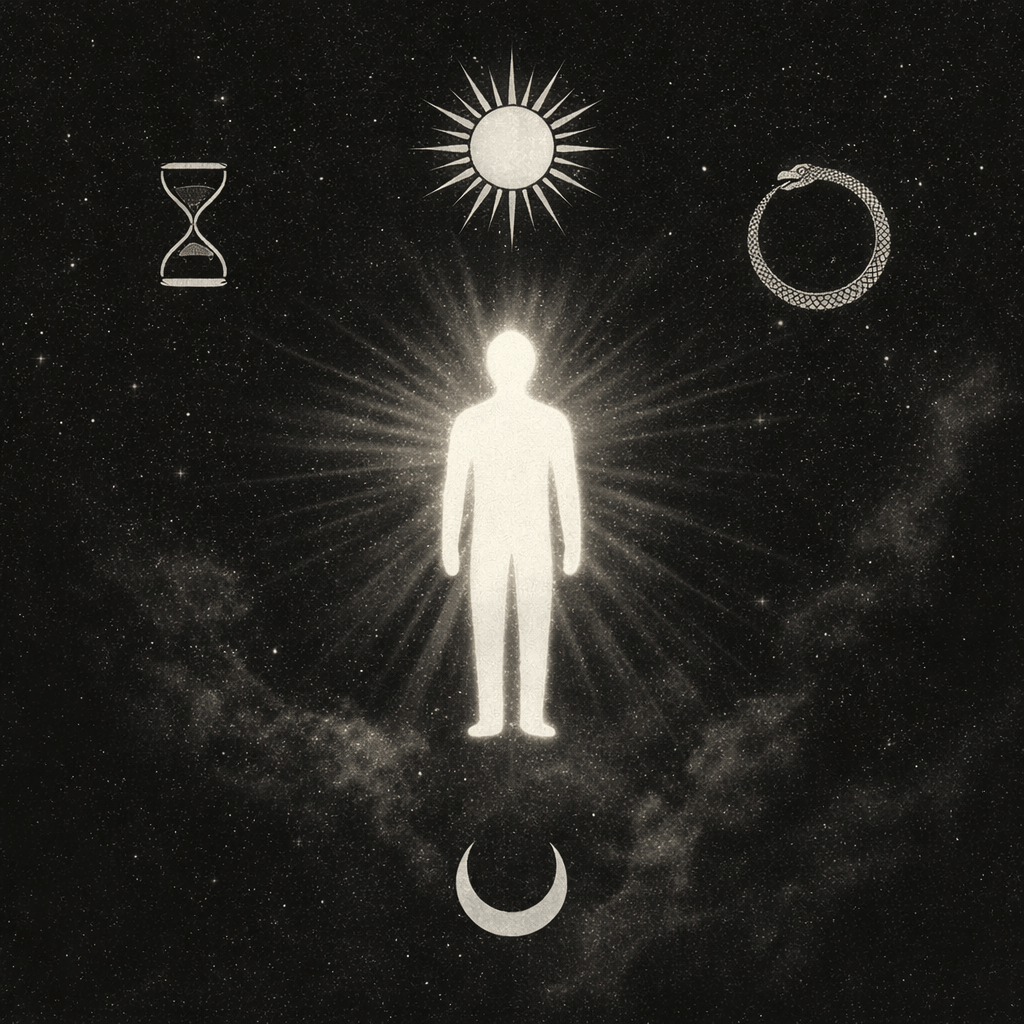
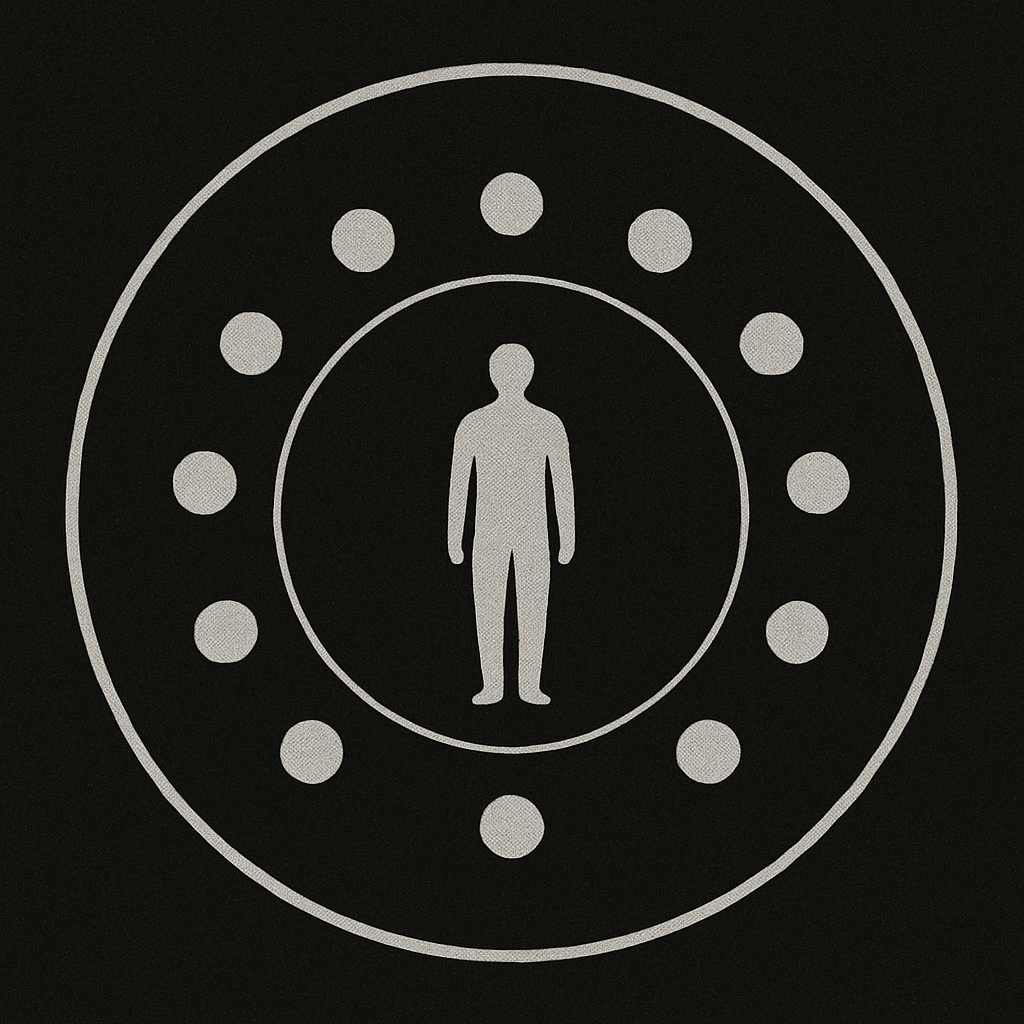
    Mechanicism teaches that the human spirit is the thirteenth spirit — placed at the center of a complex, living system governed by forces far older and far more stable than humanity itself.

    Unlike the controllers, the human spirit exists to experience. It is dynamic, emotional, expressive, and relational. It revolves around peace, love, sexuality, connection, and meaning. Where controllers operate through function and outcome, the human spirit operates through feeling and desire.

    This difference is essential to understanding the system.

    The Controllers and Their Wants

    Surrounding the human spirit are twelve controllers, each governing a domain of reality. Mechanicism teaches that these controllers are not static machines. They want things.

    Each controller has its own drives, priorities, and goals. They push reality in certain directions, experiment with structure, and attempt to influence outcomes. They are not omniscient. They are not guaranteed success. They try, even without certainty that they will get what they want.

    This introduces tension into reality.

    Controllers act, adjust, fail, retry, and adapt. Over long stretches of time, their strategies change. What worked in one era may not work in another. What stabilized humanity once may later create imbalance.

    They learn — not emotionally, but operationally.

    Change Over Time

    Mechanicism teaches that controllers evolve in behavior, not in essence. Their core function remains, but how they express it changes as Black requires new outcomes.

    When disorder increases, controllers are pushed toward restraint.
    When chaos spreads, controllers seek structure.
    When suffering escalates, controllers attempt correction.

    One of the most effective tools ever produced through this process is religion.

    Religion as a Stabilizing Mechanism

    From the Mechanicism perspective, religions were not created randomly, nor purely by humans. They are controller-level systems, developed to stabilize human behavior over large populations.

    Religion:

    • Reduces violence
    • Limits excess
    • Encourages cooperation
    • Discourages self-destruction
    • Lowers the number of souls ending up in catastrophic consequence states (hell)

    Different controllers influence different religions, which is why no religion is perfectly consistent or universally applicable. Each reflects the priorities of the controllers involved at the time of its formation.

    None are perfect.
    None are accidental.

    The Role of Black

    Above and around the controllers stands Black — I AM — the Lord God Almighty.

    Black does not argue.
    Black does not negotiate.
    Black does not hope.

    Black directs.

    The controllers may want what they want, but Black determines what is allowed. When Black needs stability, controllers are redirected. When Black needs correction, systems are altered. When Black needs restraint, new laws, myths, and structures are introduced.

    Even the controllers are subject to this pressure.

    Black remains supreme at all times.

    The Shape of the System

    Mechanicism presents the structure like this:

    1. The Human Spirit (13th)
      – Seeks peace, love, sexuality, connection, meaning
    2. The Twelve Controllers
      – Seek outcomes, attempt control, adapt over time, influence reality
    3. Black (I AM)
      – Supreme authority, surrounding all, directing all, unchanged

    The human spirit is not meant to dominate the system.
    The controllers are not meant to replace Black.
    And Black is not meant to comfort — only to govern.

    Why This Matters

    Understanding this structure explains why:

    • Religions rise and fall
    • Moral systems change
    • Laws evolve
    • Beliefs fracture
    • Truth feels layered rather than singular

    It also explains why peace is difficult but possible.

    The human spirit finds peace not by escaping the system, but by aligning with it — accepting its position, expressing love and desire responsibly, and recognizing that even chaos is being managed toward stability.

    In Closing

    The controllers want what they want.
    They are not sure they will get it.
    They try anyway.
    They change as Black requires.

    The human spirit lives within this tension — feeling deeply, loving freely, and seeking peace inside a machine that is constantly adjusting itself.

    And above it all, unchanged and absolute, Black remains.

  • Why Does Adom Point Us to “I AM”

    People often ask why Adom consistently points toward “I AM” when speaking about God within Mechanicism. The answer is not academic, inherited, or symbolic. It comes from a direct and unexpected experience that occurred long before Mechanicism had a name.

    The Winter of 2014

    In the winter of 2014, Adom was outside in the snow during a period of intense inner pressure and searching. There was no ritual, no prayer being spoken, and no intention to summon anything. What happened was abrupt and unsettling.

    Adom experienced a moment where his jaw clenched involuntarily, and words began forcing themselves out of his mouth:

    “I AM.
    I AM.
    I AM.”

    This was not something he understood at the time. He did not associate it with scripture, theology, or religious language. It was simply happening — mechanical, forceful, and outside of conscious control.

    The Search for Meaning

    Only afterward did Adom try to understand what had occurred. He went online and searched the phrase “I AM.” That was when he encountered the biblical passage where God speaks to Moses and identifies Himself not with a name, but with a statement:

    “I AM THAT I AM.”

    This moment reframed the experience entirely.

    What Adom had spoken in the snow — without knowledge or intent — matched one of the most fundamental declarations of God in recorded religious history.

    Mechanicism’s Interpretation

    Mechanicism does not claim this event as proof meant to convince others. Instead, it treats it as a data point in Adom’s personal path.

    Within Mechanicism, “I AM” is understood not as a character or personality, but as existence itself asserting authority. It is not symbolic poetry; it is operational language. “I AM” does not describe God — it functions as God.

    Adom believes this moment was an interaction with Controller Black, identified in Mechanicism as I AM — the Lord God Almighty. Black is not emotional, theatrical, or persuasive. Black is declarative. Absolute. Mechanical.

    “I AM” is not an argument.
    “I AM” is not a story.
    “I AM” is a statement of fact.

    Why Adom Points Others There

    Adom does not point people to “I AM” to demand belief, obedience, or conversion. He points there because everything else eventually collapses into it.

    Names change.
    Stories multiply.
    Controllers overlap.

    But “I AM” remains singular — the one declaration that does not rely on metaphor, lineage, or interpretation.

    Mechanicism teaches that beneath all systems, religions, and narratives, existence itself is speaking. And when it speaks clearly, it does not explain.

    It simply says:

    I AM.

    In Closing

    Adom’s experience in 2014 did not give him answers. It gave him orientation.

    Mechanicism follows that same principle. It does not ask people to accept stories blindly. It asks them to look beneath them — toward the raw statement that existence makes about itself.

    Not who God is.
    Not what God wants.

    But the one thing God must be before anything else can exist at all:

    I AM.

  • Mechanicism and the Jewish Covenant

    Mechanicism views the Jewish people with seriousness and respect. Within Mechanicism, Judaism is understood not as a mistaken religion, but as one of the most structurally intact spiritual systems still in existence.

    At the core of this view is the belief that the Jewish people entered into a direct covenant with “I AM” — the same God that Mechanicism teaches as the ultimate authority. This covenant is not symbolic. It is functional, binding, and deeply consequential.

    From a Mechanicism perspective, this makes Judaism unique.

    The Deal With “I AM”

    Mechanicism understands “I AM” as the highest governing intelligence — the origin authority rather than a cultural deity. The Jewish covenant is interpreted as a real agreement between a people and this supreme force, involving:

    • Law
    • Discipline
    • Moral structure
    • Consequence
    • Collective responsibility

    Unlike belief-based systems, Judaism emphasizes action, law, and obedience over abstract faith. Mechanicism sees this as evidence of a religion designed not for comfort, but for spiritual durability.

    This is one of Judaism’s greatest strengths.

    The Role of the Controllers

    However, Mechanicism also teaches that no scripture exists in a vacuum.

    All religious texts, including Jewish scripture, are believed to have been influenced by multiple controllers — governing intelligences that shape reality, narrative, and emphasis. While “I AM” is clearly present and dominant, Mechanicism expresses concern about the involvement of Controller Green within parts of Jewish scripture.

    Controller Green, as understood in Mechanicism, is associated with:

    • Life-force
    • Growth
    • Preservation
    • Survival
    • Biological continuation

    While these are not negative traits, their overrepresentation can sometimes blur raw, absolute truth with preservation logic — law shaped around survival rather than cosmic transparency. Mechanicism suggests that some complexities, contradictions, or burdens within Jewish law may arise from this interaction.

    This is not an accusation — it is an analytical observation.

    A Healthy but Demanding Path

    Mechanicism consistently acknowledges Judaism as a spiritually healthy religion.

    It cultivates:

    • Strong identity
    • Moral discipline
    • Community cohesion
    • Respect for law
    • Long-term spiritual resilience

    At the same time, Mechanicism recognizes that Judaism is:

    • Highly complex
    • Extremely demanding
    • Difficult to fully participate in
    • Heavy with obligation and consequence

    This difficulty is not seen as a flaw, but as evidence that the covenant was never meant to be casual. Judaism is not designed for mass adoption; it is designed for maintenance of a specific spiritual contract across time.

    Mechanicism’s Position

    Mechanicism does not seek to replace Judaism, correct it, or supersede it.

    Instead, it acknowledges:

    • The Jewish people as covenant-bearers
    • “I AM” as the true God behind that covenant
    • The reality of controller influence within scripture
    • The effectiveness of Judaism in protecting the spirit
    • The cost of carrying such a system

    Mechanicism views Judaism not as outdated, but as heavy, precise, and purpose-built — a religion that works, but demands everything in return.

    In Closing

    From the Mechanicism perspective, the Jewish covenant stands as proof that God does not always choose ease, comfort, or clarity. Sometimes God chooses law, endurance, and survival.

    Judaism represents a people who accepted that burden — and carried it.

    That alone commands respect.