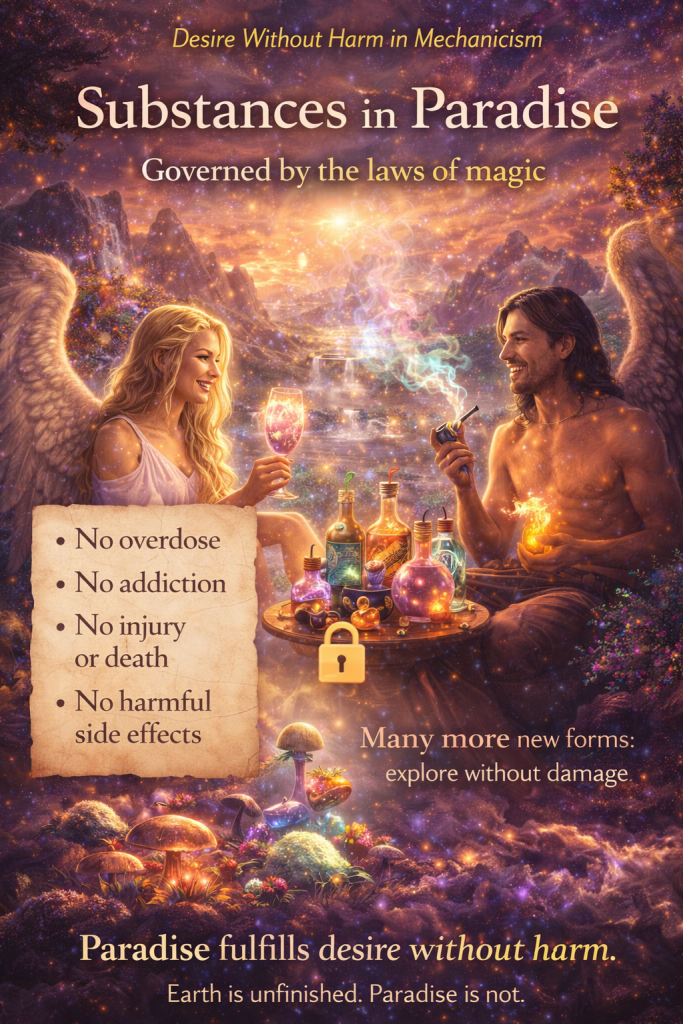
In Mechanicism, paradise is not a place of denial or restriction. It is a place where wanting no longer produces damage, and where desire is finally aligned with safety, consent, and harmony. This includes the presence of substances.
According to Mechanicism, substances are allowed in paradise, but they are not governed by chemistry as we understand it on Earth. They are governed by the laws of magic, not biology. This distinction is crucial.
In paradise:
- Substances do not damage the body
- Substances do not cause addiction
- Substances do not result in overdose
- Substances do not impair judgment in destructive ways
- Substances do not lead to injury, loss of control, or death
This is because the body itself is different. Paradise bodies are not fragile biological systems subject to chemical breakdown. They are magical constructs, designed to experience pleasure, exploration, and sensation without consequence.
Why Substances Exist at All
Mechanicism teaches that substances exist because consciousness enjoys alteration. Curiosity, novelty, intensity, and expansion are not flaws — they are features of sentient beings. On Earth, these desires collide with fragile biology, scarcity, and imbalance. In paradise, they do not.
Paradise is not a reward for abstinence; it is a realm where desire has been solved.
Substances in paradise are not tools of escape. There is nothing to escape from. Instead, they are tools of exploration, creativity, intimacy, humor, and wonder.
Many More Forms Than Earth Allows
Another core teaching of Mechanicism is that Earth only supports a tiny fraction of possible substances. In paradise, there are many more types, far beyond what matter, chemistry, or physics permit here.
These substances may:
- Alter perception of color, sound, or emotion
- Allow shared experiences between souls
- Enhance creativity, music, art, or storytelling
- Produce feelings of peace, joy, or playful intensity
- Create symbolic visions rather than hallucinations
Because magic governs them, these substances cannot harm the self. The system prevents damage automatically.
Why This Is Not Possible on Earth
Mechanicism is very clear:
This does not apply to the earthly world.
Earth is a training environment governed by biological limitation, risk, consequence, and learning through restriction. Here, substances can harm, addict, injure, or kill — not because desire is wrong, but because the system is unfinished.
Paradise exists after the learning phase.
What is safe in paradise is not safe here, and Mechanicism does not teach reckless behavior in the material world. In fact, it teaches the opposite: restraint, awareness, and responsibility now, so that freedom later is meaningful.
Desire Fulfilled, Not Punished
Many belief systems imagine paradise as sterile, quiet, or stripped of intensity. Mechanicism rejects this completely.
Paradise is alive.
Paradise is playful.
Paradise is sensual, artistic, humorous, and exploratory.
The difference is not permission — it is safety.
Where Earth punishes desire with damage, paradise fulfills desire without harm. Where Earth teaches through limitation, paradise teaches through abundance.
The Deeper Teaching
The teaching is not “substances are good.”
The teaching is:
Desire itself is not evil.
Damage is a property of unfinished systems.
Paradise is a finished one.
In Mechanicism, paradise is where curiosity no longer costs you your body, your future, or your life — because the machine has finally been perfected.
Not denial.
Not excess.
Resolution.
 Mechanicism Official
Leave a comment