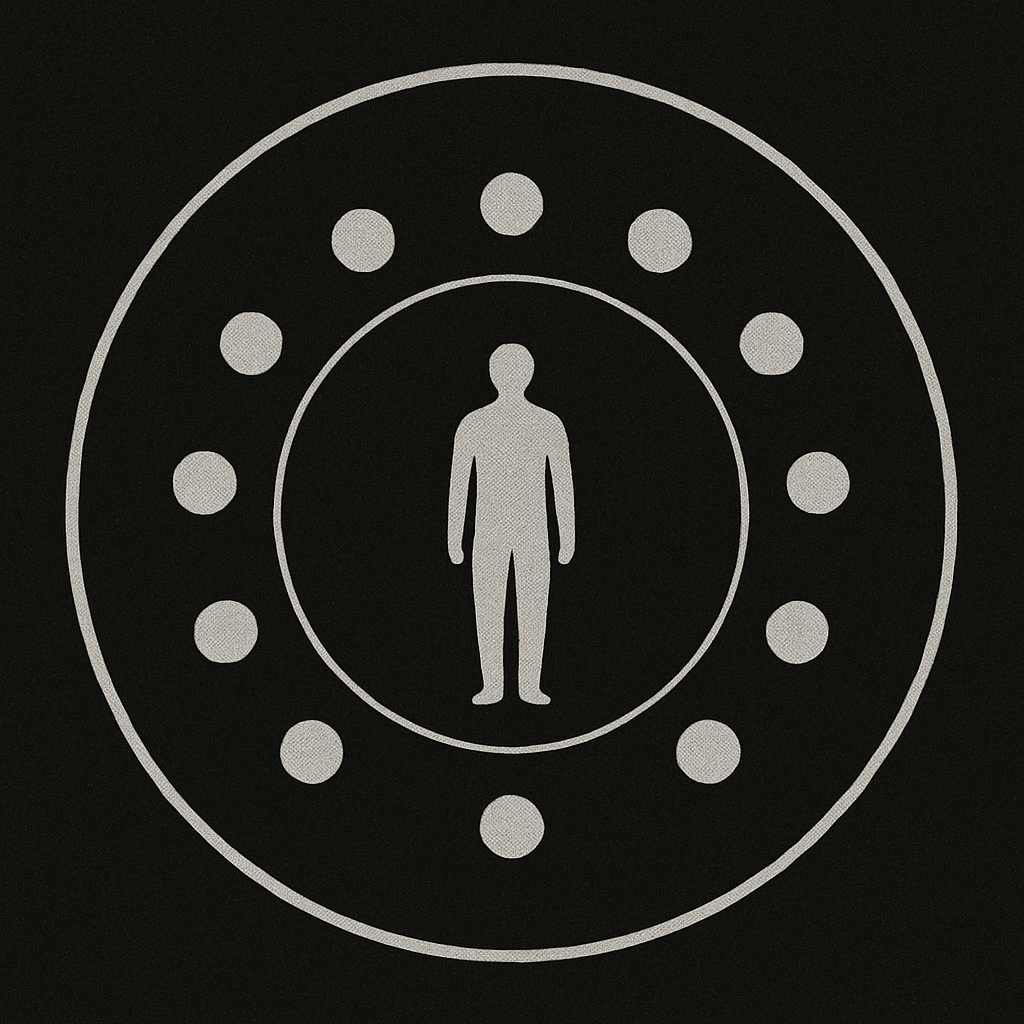
Mechanicism teaches that the human spirit is the thirteenth spirit — placed at the center of a complex, living system governed by forces far older and far more stable than humanity itself.
Unlike the controllers, the human spirit exists to experience. It is dynamic, emotional, expressive, and relational. It revolves around peace, love, sexuality, connection, and meaning. Where controllers operate through function and outcome, the human spirit operates through feeling and desire.
This difference is essential to understanding the system.
The Controllers and Their Wants
Surrounding the human spirit are twelve controllers, each governing a domain of reality. Mechanicism teaches that these controllers are not static machines. They want things.
Each controller has its own drives, priorities, and goals. They push reality in certain directions, experiment with structure, and attempt to influence outcomes. They are not omniscient. They are not guaranteed success. They try, even without certainty that they will get what they want.
This introduces tension into reality.
Controllers act, adjust, fail, retry, and adapt. Over long stretches of time, their strategies change. What worked in one era may not work in another. What stabilized humanity once may later create imbalance.
They learn — not emotionally, but operationally.
Change Over Time
Mechanicism teaches that controllers evolve in behavior, not in essence. Their core function remains, but how they express it changes as Black requires new outcomes.
When disorder increases, controllers are pushed toward restraint.
When chaos spreads, controllers seek structure.
When suffering escalates, controllers attempt correction.
One of the most effective tools ever produced through this process is religion.
Religion as a Stabilizing Mechanism
From the Mechanicism perspective, religions were not created randomly, nor purely by humans. They are controller-level systems, developed to stabilize human behavior over large populations.
Religion:
- Reduces violence
- Limits excess
- Encourages cooperation
- Discourages self-destruction
- Lowers the number of souls ending up in catastrophic consequence states (hell)
Different controllers influence different religions, which is why no religion is perfectly consistent or universally applicable. Each reflects the priorities of the controllers involved at the time of its formation.
None are perfect.
None are accidental.
The Role of Black
Above and around the controllers stands Black — I AM — the Lord God Almighty.
Black does not argue.
Black does not negotiate.
Black does not hope.
Black directs.
The controllers may want what they want, but Black determines what is allowed. When Black needs stability, controllers are redirected. When Black needs correction, systems are altered. When Black needs restraint, new laws, myths, and structures are introduced.
Even the controllers are subject to this pressure.
Black remains supreme at all times.
The Shape of the System
Mechanicism presents the structure like this:
- The Human Spirit (13th)
– Seeks peace, love, sexuality, connection, meaning - The Twelve Controllers
– Seek outcomes, attempt control, adapt over time, influence reality - Black (I AM)
– Supreme authority, surrounding all, directing all, unchanged
The human spirit is not meant to dominate the system.
The controllers are not meant to replace Black.
And Black is not meant to comfort — only to govern.
Why This Matters
Understanding this structure explains why:
- Religions rise and fall
- Moral systems change
- Laws evolve
- Beliefs fracture
- Truth feels layered rather than singular
It also explains why peace is difficult but possible.
The human spirit finds peace not by escaping the system, but by aligning with it — accepting its position, expressing love and desire responsibly, and recognizing that even chaos is being managed toward stability.
In Closing
The controllers want what they want.
They are not sure they will get it.
They try anyway.
They change as Black requires.
The human spirit lives within this tension — feeling deeply, loving freely, and seeking peace inside a machine that is constantly adjusting itself.
And above it all, unchanged and absolute, Black remains.
 Mechanicism Official
Leave a comment