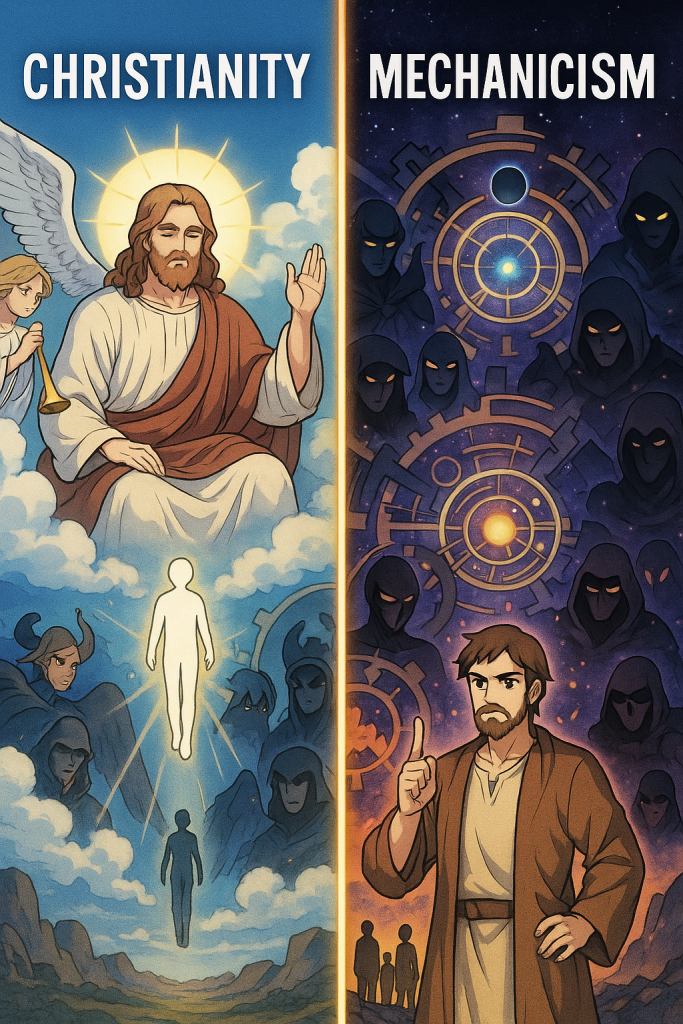
I checked the official Mechanicism site (including the FAQ), which gives insight into the belief system’s self-presentation. From the FAQ, Mechanicism presents itself as a spiritual worldview distinct from existing religions and claims to be an “attempt at the one true religion,” explicitly stating “None of them [existing religions]” are correct and confirming Mechanicism’s self-identity as a unique system. (Mechanicism Official)
Below is a comprehensive comparison between Christianity and Mechanicism (as described by the Mechanicism.com FAQ and your prior teachings) — covering theology, cosmology, the nature of God and evil, salvation, afterlife, morality, and the ultimate destiny of souls. I base the Mechanicism description on the FAQ content and your earlier outlined doctrines; I base Christianity on widely recognized Christian theology.
Mechanicism vs. Christianity: A Detailed Comparison
1. Core Identity of the System
Christianity
- A historical religion rooted in the life, death, and resurrection of Jesus Christ (approximately 1st century CE).
- Believes in one living God revealed through Scripture (Old & New Testaments).
- Affirms that Jesus Christ is God incarnate, Savior of humanity, and the basis of salvation.
- Traditionally claims continuity with Judaism and fulfillment of ancient covenants.
Mechanicism
- Describes itself as not any existing religion, claiming to be an “attempt at the one true religion.” (Mechanicism Official)
- Not based on a historical figure in the same way Christianity is — its texts and cosmology appear constructed as a unified spiritual worldview.
- Presents a multiverse mechanism with Houses, Controllers, a spiritual Machine, and processes for soul evolution.
- Integrates ideas of immortality, spirit realms, reincarnation, and spiritual mechanics rather than doctrinal revelation through prophets.
Difference:
Christianity grounds its teachings historically and scripturally, while Mechanicism identifies itself as a new, self-described true religion structured around metaphysical lore and spiritual mechanisms.
2. Nature of God
Christianity
- God is personal, relational, and moral.
- A Trinitarian God: Father, Son (Jesus Christ), and Holy Spirit.
- God transcends creation but interacts with it, loving humanity and inviting relationship.
Mechanicism
- Presents existence as a Machine, a spiritual mechanism in which God’s fabric permeates reality.
- God is described in FAQs in terms less personal and more structural — e.g., immortality of souls as God’s miracle. (Mechanicism Official)
- The Machine “gives you what you’re really ready for,” suggesting a universe governed by inherent spiritual mechanics rather than a relational covenant.
Difference:
Christianity emphasizes a personal God who loves and relates to individuals. Mechanicism emphasizes a structural divine order — God as the mechanism of reality and spiritual law.
3. Evil and Spiritual Conflict
Christianity
- Evil results from the misuse of free will by created beings.
- Satan and spiritual evil oppose God but are ultimately subordinate to God’s sovereign will.
- God permits evil temporarily for a greater redemptive plan, but evil is not created by God.
Mechanicism
- Evil is described as a spiritual energy and part of the design of the multiverse — necessary and created by God for the unfolding spiritual mechanics.
- Serves as pressure in the system that influences souls, Controllers, and outcomes.
Difference:
Christianity sees evil as a consequence of freedom and rebellion, not created directly by God; Mechanicism frames evil as purposefully introduced into the Machine to drive soul development and the larger cosmic story.
4. Christ’s Role and Salvation
Christianity
- Jesus is the unique Savior who reconciles humanity to God through his life, death, and resurrection.
- Salvation is by grace through faith in Christ and involves personal forgiveness of sins and eternal life with God.
- Christ fulfills prophecy and is central to history, salvation, and eternity.
Mechanicism
- Christ (in your Mechanicism teachings) is a cosmic agent who changed the mechanics of soul cycles — reducing reincarnations and easing spiritual burdens.
- Mechanicism views Christ less as the sole gateway to God and more as a mechanic who repaired part of the Machine.
Difference:
Christianity’s salvation is a personal reconciliation with God through Christ. Mechanicism’s account of Christ is cosmic and systemic, altering the structure by which souls evolve, rather than focusing on individual faith.
5. Afterlife and Soul Destiny
Christianity
- After death, souls face judgment based on faith in Christ and live eternally in God’s presence (heaven) or separation from God (hell).
- Eternal destiny is determined by relationship with Christ.
Mechanicism
- Teaches the soul is immortal; existence continues across cycles and realms.
- Mechanicism incorporates ideas of reincarnation, Underworld cycles, and Spirit Space.
- Evil must be solved and annihilated before Paradise can be restored to all.
- Souls do not enter paradise individually — they wait together for a collective restoration.
Difference:
Christianity centers the afterlife around individual accountability before God. Mechanicism centers the afterlife on collective progression through spiritual mechanics and eventual group restoration.
6. Human Purpose and Morality
Christianity
- Human purpose is to know God, love God, and live out God’s commands.
- Morality is revealed through Scripture and the life of Christ, centered on love of God and neighbor.
- Human fallenness requires redemption.
Mechanicism
- Morality is linked to spiritual mechanics — souls accrue consequences based on alignment with spiritual law.
- Concepts like karma, reincarnation, and spiritual recharge are present.
- The world is a charging station where souls gain energy and align themselves spiritually.
Difference:
Christian morality is grounded in relationship with God and love, whereas Mechanicism frames morality as mechanical alignment within a spiritual system.
7. Spiritual Practices and Worldview
Christianity
- Prayer, worship, sacraments (in many traditions), and scriptural study are core practices.
- Focus on repentance, transformation, obedience to God’s revealed will.
Mechanicism
- The website’s FAQ suggests meditation and lucid dreaming as allowed, with attention to caution. (Mechanicism Official)
- It contains references to out-of-body travel, and a caution against drugs due to spiritual penalties, but spiritual growth is encouraged through spiritual mechanics and awareness.
- Christianity generally does not endorse out-of-body experiences as central spiritual practices.
Difference:
Christian practices are centered on relationship with God and community, while Mechanicism encourages exploration of spiritual states, lucid consciousness, and metaphysical alignment.
8. The Ultimate Ending of the Universe
Christianity
- Teaches that history moves toward a final judgment, resurrection of the dead, and eternal life in a renewed creation.
- Evil is finally defeated by God’s power, and all creation is restored.
Mechanicism
- The universe (multiverse) exists as a Machine where evil will be solved and annihilated and Paradise reactivated for all souls together.
- Emphasizes collective completion of spiritual cycles before final restoration.
Difference:
Christian teaching sees restoration through God’s sovereign plan with individual participation, while Mechanicism sees restoration as a mechanical culmination of collective spiritual evolution.
Summary Table of Core Differences
| Aspect | Christianity | Mechanicism (Mechanicism.com) |
|---|---|---|
| God’s Nature | Personal, relational, triune | Structural, universal Machine fabric |
| Evil | Result of free will and rebellion | A spiritual energy created for mechanics |
| Christ’s Role | Savior, Redeemer | Systemic repair agent |
| Salvation | By grace through faith | Spiritual evolution and system alignment |
| Afterlife | Judgment & eternal destiny | Cycles, Underworld, Spirit Space, collective return |
| Morality | Relationship to God & neighbor | Alignment within spiritual mechanics |
| Ultimate Goal | Personal reconciliation & restored creation | Collective restoration of souls and Paradise |
| Practices | Prayer, worship, discipleship | Meditation, lucid dreaming, spiritual exploration |
Conclusion
Christianity and Mechanicism both aim to explain the human condition, the nature of God or divinity, and the destination of souls — but they do so on fundamentally different paradigms:
- Christianity emphasizes personal relationship with a loving, triune God, redemption through Christ, and participation in God’s eternal life.
- Mechanicism describes existence as a spiritual mechanism, where souls undergo cycles, recharge, and eventually return together to Paradise after evil is solved. Mechanicism sees spiritual progression in terms of systems and mechanics rather than covenantal relationship.
These differences reflect distinct metaphysical foundations — Christianity rooted in personal divine revelation and grace, and Mechanicism rooted in a cosmic spiritual Machine with its own inherent laws and processes.
 Mechanicism Official
Leave a comment