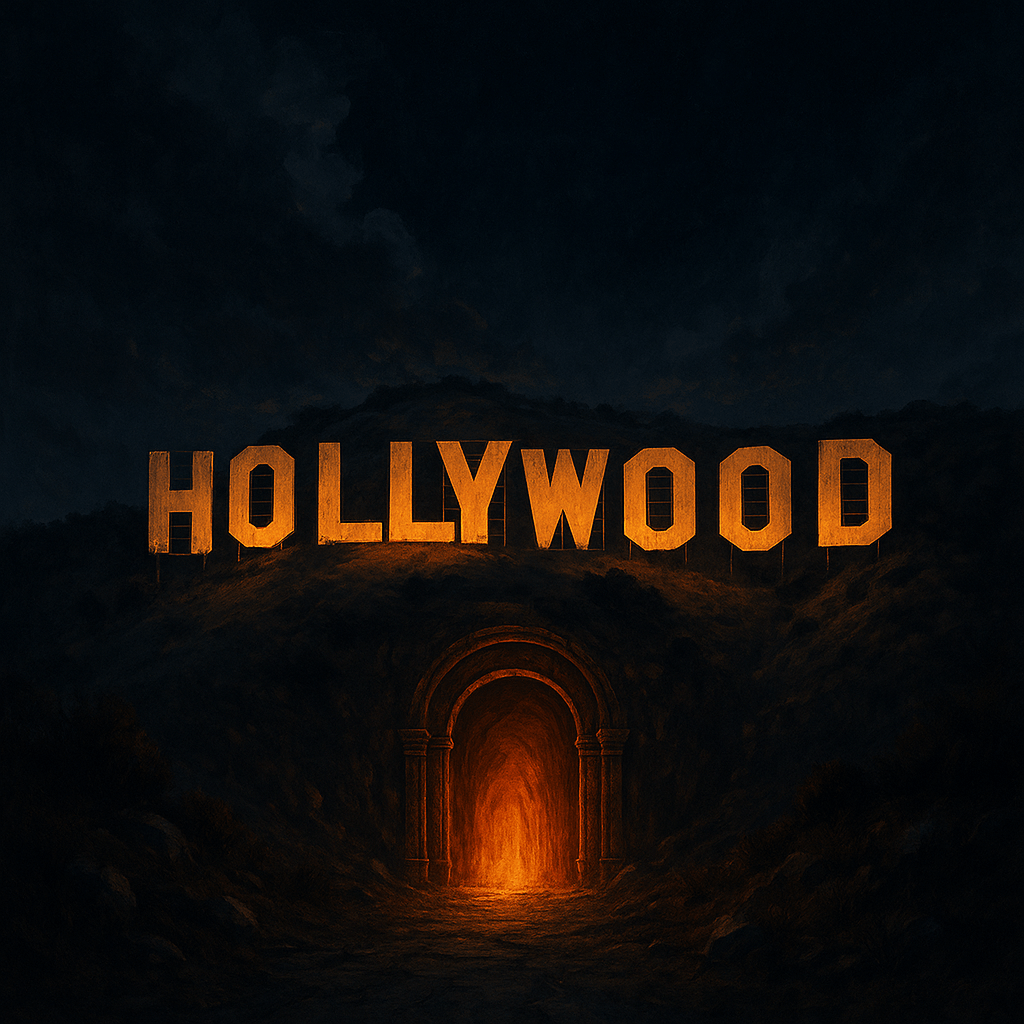
For more than a century, Hollywood has stood as a shimmering beacon of imagination—golden lights glowing against velvet night, projecting dreams onto the largest canvases Earth has ever built. But beneath the glamour, beneath the premieres, beneath the endless reels of stories, there is a deeper mythology at work. Hollywood is not just a physical place, nor merely an industry. It is a symbolic portal: a threshold between the world of the living and the unseen realms where memory, myth, and the human psyche dwell.
It functions much like the mythic entrances to the Underworld described in ancient cultures—places where heroes descended to confront shadows, retrieve wisdom, or return transformed. Hollywood is not an underworld of literal death, but of archetypal descent, where stories travel into humanity’s subconscious territories and emerge re-shaped, glowing with the energy of something beyond ordinary life.
The Stage as a Threshold
In mythology, doors to the Underworld were not always dark caverns or spiritual gateways. Sometimes they were stages.
When ancient Greeks performed tragedies in the open air, the audience entered a psychological underworld. Characters confronted fate, loss, madness, hubris, and redemption—journeys symbolic of death and rebirth within the human spirit. Watching a tragedy was never passive; it was emotional excavation.
Hollywood inherited this tradition and magnified it.
Films are modern rituals where viewers descend collectively into shared dreamspace.
In a dark theater:
- time stops,
- the world fades,
- and we enter the realm of symbols, memory, fear, longing, and myth.
The Underworld is not a place of punishment in this context—it is the interior of consciousness, and cinema is one of the few modern arts that consistently opens the door to that space.
The Actor as a Traveler Between Worlds
Actors often speak as though they “become” other people, other lives, sometimes slipping into emotions, traumas, joys, or spiritual states that do not belong to their waking identity. In myth, this is the work of a psychopomp—a guide who can walk between realms without being consumed by either.
Through performance, actors channel:
- ancient archetypes,
- forgotten stories,
- characters long dead,
- legends resurrected and reshaped.
When an actor plays a role based on a real individual who has passed on, they become a symbolic bridge—reviving memory, voice, and presence. In this sense, Hollywood keeps countless stories “alive,” carrying them across the boundary of time.
Cinema makes the past speak again.
The Underworld as the Collective Shadow
Every society has a shadow—the aspects of humanity that individuals avoid confronting directly. Stories are one of the oldest methods for exploring that shadow safely. Hollywood’s fascination with crime dramas, supernatural tales, dystopias, and psychological thrillers reflects this ancient impulse.
Mythologically, the Underworld was where:
- the unspoken truths lived,
- the unhealed wounds slept,
- and the lessons of mortality waited to be understood.
Hollywood’s darker genres serve the same function. They allow us to face fear without danger, loss without finality, grief without collapse. They also help cultures examine injustice, trauma, or moral dilemmas indirectly, through symbol and narrative.
The silver screen becomes a mirror to the parts of ourselves that sunlight cannot reveal.
Icons, Legacy, and the Realm Beyond Time
When a performer dies, their roles continue breathing on screen. Their voice, movement, energy, and presence remain accessible to generations who were never alive at the same time. This is one of Hollywood’s quiet mysteries:
it preserves echoes of people long after the grave has closed.
Not in a haunted or literal sense, but in the way memory becomes immortalized through art. Film allows a human spirit—its creativity, expression, and emotional truth—to transcend the boundaries of life.
This is not the Underworld of mythic darkness; it is the Underworld of legacy, where the past continues to influence the living.
Every reel of film, every digital archive, is a vault of countless preserved lives.
Myth, Modernity, and the Return to the Surface
In classical stories, the hero returns from the Underworld with a treasure:
- a truth,
- a lesson,
- or a new understanding of life.
Likewise, when we leave a movie theater or finish a film at home, we return changed—however subtly. We carry with us the emotional gold dug from the depths:
- empathy for people we’ve never met,
- courage from characters who never existed,
- clarity on fears we didn’t know we held,
- inspiration to act, create, or transform.
This return journey is what makes cinema a mythic ritual.
Hollywood is the doorway—but what we bring back determines whether the descent had meaning.
Conclusion: A Portal Made of Light
The lights of Hollywood do not illuminate an actual Underworld—they illuminate the pathways to the symbolic one, the internal landscape every human carries. Through story, art, memory, and performance, Hollywood opens doorways that lead inward and downward, into the depths of the human condition.
It is a realm where:
- myths resurrect,
- legacies converse with the living,
- fears transform,
- and imagination becomes a bridge between worlds.
Hollywood is not the Underworld taught in myths—it is the modern temple where we safely explore what those myths were always trying to teach:
that the borders between life, memory, imagination, and meaning are thin, and every story is a doorway to a realm beyond the ordinary world.
 Mechanicism Official
Leave a comment